


Psychosocial Risk Management Doesn't Need to Be Complicated
- Jessica Urquhart

- 5 days ago
- 4 min read
The introduction of psychosocial hazard regulations has left many organisations asking the same question:
"Where do we start?"
For some businesses, the response has been to create entirely new systems, lengthy registers and complicated processes that quickly become difficult to maintain. The reality is much simpler.
Effective psychosocial risk management does not require organisations to reinvent the wheel. In most cases, the foundations already exist within your current risk management, health and safety, human resources, leadership and performance management systems.
The challenge is not creating more paperwork. The challenge is identifying the psychosocial hazards that genuinely exist in your workplace and ensuring appropriate controls are in place, monitored and reviewed.
Psychosocial risk management doesn't need to be complicated.
The Problem with Generic Psychosocial Risk Registers
Some organisations have developed a single psychosocial risk register containing broad hazards such as:
Job demands
Poor support
Bullying
Harassment
Violence
Poor role clarity
While these hazards are relevant, a single organisation-wide register often fails to identify the specific psychosocial exposures experienced by different roles.
Consider the difference between:
A General Manager responsible for political pressure, governance and public scrutiny.
A Project Manager responsible for budgets, contractors and project delivery.
A Customer Service Officer dealing with frustrated members of the public.
An apprentice learning new skills while working under supervision.
Each role faces very different psychosocial hazards.
If we rely solely on a generic organisational risk register, critical exposures may never be identified or adequately controlled.
Why Role-Based Psychosocial Risk Assessments Matter
Role-based psychosocial risk assessments examine the actual duties, responsibilities, relationships and work environment associated with a position. Instead of asking:
"What psychosocial hazards exist within the organisation?"
We ask:
"What psychosocial hazards are reasonably foreseeable for this role?"
This approach creates a far more accurate understanding of risk.
By identifying hazards at the role level, organisations can develop targeted controls that address actual sources of harm rather than relying on generic solutions.
Building on Existing Systems
One of the biggest misconceptions is that psychosocial risk management requires an entirely separate management system. In reality, many organisations already have controls in place.
Examples include:
Workforce planning processes
Performance management systems
Leadership development programs
Employee Assistance Programs (EAP)
Consultation processes
Incident reporting systems
Grievance and complaint procedures
Flexible work arrangements
Training and competency programs
The objective is to identify which existing systems are managing psychosocial risk and determine whether they are effective.
A Practical Psychosocial Hierarchy of Control
Traditional safety risks often use the hierarchy of control.

Psychosocial hazards should be managed in a similar way.

The hierarchy should focus on:
1. Elimination
Remove the hazard entirely.
Remove unreasonable workloads
Eliminate unnecessary after-hours contact
Remove exposure to traumatic material where practicable
2. Substitution
Replace higher-risk activities with safer alternatives.
Automate repetitive administrative tasks
Redistribute workloads
Introduce alternative communication methods
3. Engineering and Environmental Controls
Modify the physical environment or systems.
Security systems
Duress alarms
Automated workflows
4. Work Design
Often the most important psychosocial control.
Role clarity
Workload management
Resource allocation
Consultation processes
5. Administrative Controls
Policies
Procedures
Training
Supervision
6. Support and Recovery
EAP
Counselling
Critical incident support
Return to work programs
Understanding Control Types
Many organisations focus heavily on response and recovery controls while neglecting preventative controls.

An effective framework should include four control types:
Preventative Controls
Controls designed to stop psychosocial hazards from causing harm.
Examples:
Workload planning
Consultation
Role design
Flexible work arrangements
Monitoring Controls
Controls that identify emerging risks.
Examples:
Worker surveys
Team meetings
Leading indicators
Hazard reporting systems
Response Controls
Controls that activate when issues occur.
Examples:
Grievance procedures
Incident management
Conflict resolution processes
Recovery Controls
Controls that support workers after exposure.
Examples:
EAP
Counselling
Peer support
Return to work programs
Measuring Control Effectiveness
A common weakness in psychosocial risk management is assuming controls are effective simply because they exist.
The existence of a policy does not mean the risk is controlled.
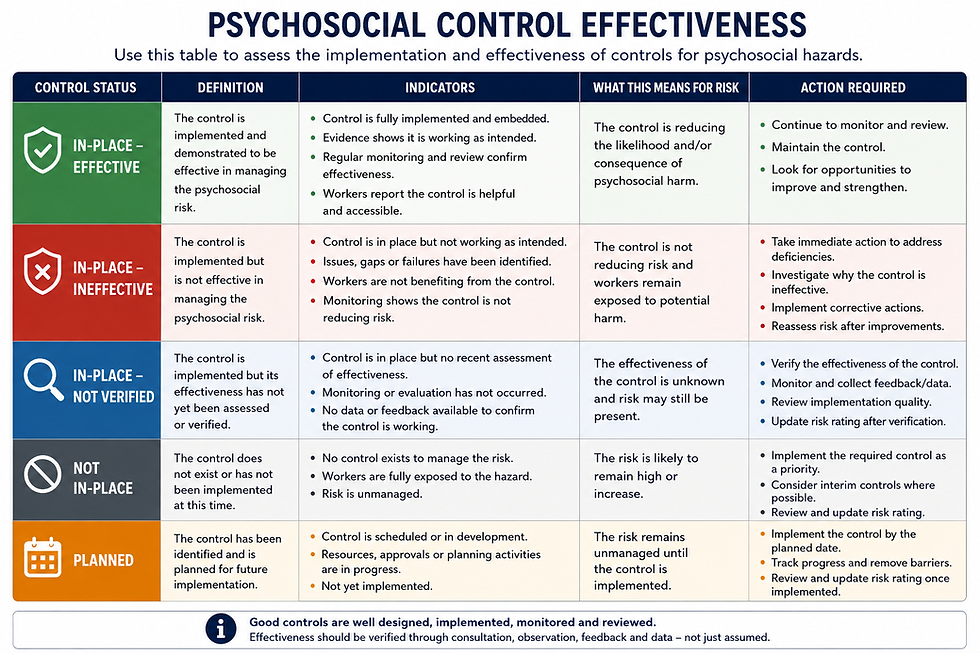
A practical approach is to classify controls as:
In Place – Effective
Evidence demonstrates the control is working as intended.
In Place – Ineffective
The control exists but is not reducing risk.
In Place – Not Verified
The control exists but effectiveness has not been assessed.
Not In Place
The control does not exist.
Planned
The control has been identified but has not yet been implemented.
This approach shifts organisations away from compliance-based thinking and towards evidence-based risk management.
Rethinking Likelihood
Traditional risk assessments often determine likelihood based on historical events. Psychosocial hazards are different.
The likelihood of harm should be assessed based on:
Work design
Leadership practices
Resource allocation
Control effectiveness
Monitoring arrangements
Organisational culture
A workplace with effective preventative controls should have a lower likelihood rating than one relying solely on policies and resilience training.
Applying a Psychosocial Risk Matrix
A psychosocial risk matrix should combine:
Consequence of harm
Likelihood based on control effectiveness

This allows organisations to prioritise resources and focus attention on the most significant risks.
Importantly, a catastrophic psychosocial outcome such as suicide, permanent psychological injury or widespread workforce harm should never be dismissed simply because historical incidents have not occurred.
From Compliance to Prevention
The intent of psychosocial legislation is not to create more paperwork. The intent is to prevent harm.
Organisations that achieve the best outcomes typically:
Understand role-specific exposures.
Use existing systems rather than creating duplicate processes.
Focus on work design and leadership.
Verify control effectiveness.
Monitor psychosocial risks over time.
Continually improve their controls.
Psychosocial risk management does not need to be overwhelming. By combining:
A practical hierarchy of control
Clearly defined control types
Control effectiveness verification
A suitable risk matrix
Role-based psychosocial risk assessments
Organisations can build a simple, sustainable and defensible framework that aligns with legislative requirements while focusing on what matters most: protecting the health, wellbeing and performance of their people.
The organisations that will succeed are not those with the largest psychosocial risk registers, they will be the organisations that understand the specific hazards faced by their workers and implement effective controls to manage them.
Psychosocial Risk Management Doesn't Need to Be Complicated
Need help developing a practical psychosocial risk management framework or role-based psychosocial risk assessments for your organisation?
Orana Skills Centre assists organisations to identify psychosocial hazards, develop tailored control frameworks, assess control effectiveness and build sustainable systems that integrate with existing HR, WHS and risk management processes.
Contact us to discuss how a role-based approach can strengthen your psychosocial risk management program.


Comments