top of page
Psychosocial Risk Management Trainer

Psychosocial Risk Management

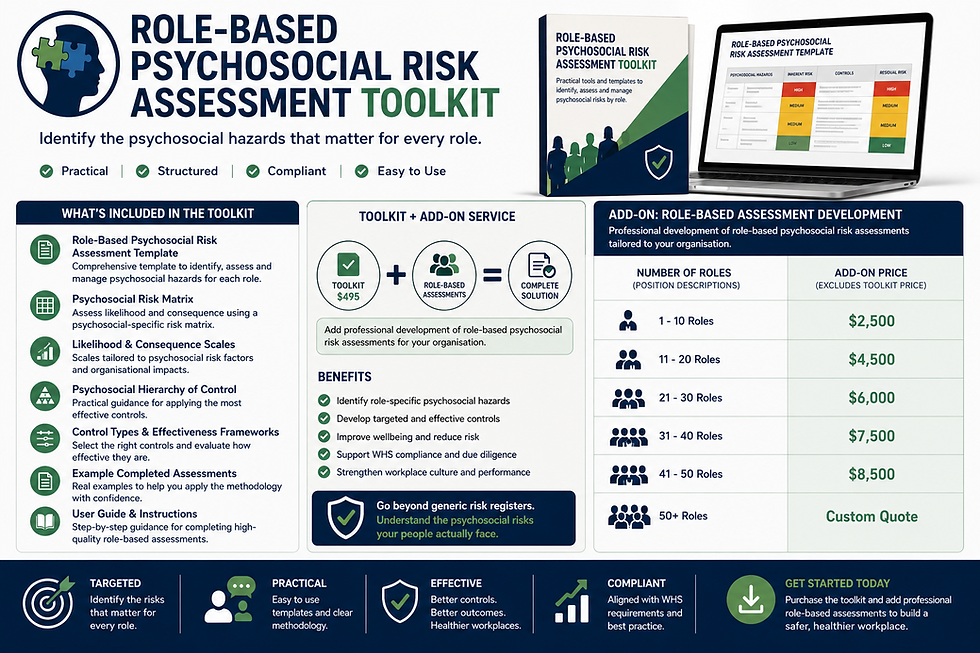
Psychosocial hazards are factors in the workplace that can negatively impact an employee's mental health, wellbeing, and safety. These include work-related stress, bullying, harassment, fatigue, violence, and poor organisational culture, which can lead to serious psychological and physical health outcomes.

2026 Professional Development Calendar

  • 2-Day Psychosocial Risk Register Workshop
    2-Day Psychosocial Risk Register Workshop
    Multiple Dates
    Wed, 18 Feb
    18 Feb 2026, 9:00 am AEDT – 19 Feb 2026, 5:00 pm AEDT
    Orana Skills Centre, 31-37 Macquarie St, Dubbo NSW 2830, Australia
    Identify hazards, analyse exposure, build a live risk register your business can use immediately
  • Psychosocial Risk Leadership
    Psychosocial Risk Leadership
    Multiple Dates
    Wed, 18 Feb
    Orana Skills Centre
    18 Feb 2026, 9:00 am – 5:00 pm AEDT
    Orana Skills Centre, 31-37 Macquarie St, Dubbo NSW 2830, Australia
    Understanding, managing and leading psychosocial risk in the workplace
  • Psychosocial Risk Register Course
    Psychosocial Risk Register Course
    Multiple Dates
    2 days to the event
    Thu, 19 Feb
    Orana Skills Centre
    19 Feb 2026, 9:00 am – 5:00 pm AEDT
    Orana Skills Centre, 31-37 Macquarie St, Dubbo NSW 2830, Australia
    Building, implementing and maintaining a compliant psychosocial risk register
  • Risk Owner (RO)
    Risk Owner (RO)
    Multiple Dates
    7 days to the event
    Tue, 24 Feb
    Orana Skills Centre
    24 Feb 2026, 9:00 am – 5:00 pm AEDT
    Orana Skills Centre, 31-37 Macquarie St, Dubbo NSW 2830, Australia
    Build leadership capability and accountability for high-consequence risk
  • Critical Control Owner (CCO)
    Critical Control Owner (CCO)
    Multiple Dates
    8 days to the event
    Wed, 25 Feb
    Orana Skills Centre
    25 Feb 2026, 9:00 am – 5:00 pm AEDT
    Orana Skills Centre, 31-37 Macquarie St, Dubbo NSW 2830, Australia
    Ensure critical controls remain effective and never fail when needed most
  • Risk Management System Auditing
    Risk Management System Auditing
    Multiple Dates
    14 days to the event
    Tue, 03 Mar
    Orana Skills Centre
    03 Mar 2026, 9:00 am – 5:00 pm AEDT
    Orana Skills Centre, 31-37 Macquarie St, Dubbo NSW 2830, Australia
    Strengthen compliance, validate control effectiveness, lift assurance maturity
  • Risk Bowtie Analysis Course
    Risk Bowtie Analysis Course
    Multiple Dates
    17 days to the event
    Fri, 06 Mar
    Orana Skills Centre - White Room
    06 Mar 2026, 9:00 am – 5:00 pm AEDT
    Orana Skills Centre - White Room, 31-37 Macquarie St, Dubbo NSW 2830, Australia
    Visualise risk. Strengthen controls. Prevent serious events.
  • Critical Control Management Course
    Critical Control Management Course
    Multiple Dates
    24 days to the event
    Fri, 13 Mar
    Orana Skills Centre - White Room
    13 Mar 2026, 9:00 am – 5:00 pm AEDT
    Orana Skills Centre - White Room, 31-37 Macquarie St, Dubbo NSW 2830, Australia
    Master control assurance, prevent the failure that causes catastrophic events
  • Risk Owner (RO)
    Risk Owner (RO)
    Multiple Dates
    35 days to the event
    Tue, 24 Mar
    Orana Skills Centre
    24 Mar 2026, 9:00 am – 5:00 pm AEDT
    Orana Skills Centre, 31-37 Macquarie St, Dubbo NSW 2830, Australia
    Build leadership capability and accountability for high-consequence risk
  • Critical Control Owner (CCO)
    Critical Control Owner (CCO)
    Multiple Dates
    36 days to the event
    Wed, 25 Mar
    Orana Skills Centre
    25 Mar 2026, 9:00 am – 5:00 pm AEDT
    Orana Skills Centre, 31-37 Macquarie St, Dubbo NSW 2830, Australia
    Ensure critical controls remain effective and never fail when needed most
  • Psychosocial Risk Leadership
    Psychosocial Risk Leadership
    Multiple Dates
    41 days to the event
    Mon, 30 Mar
    Orana Skills Centre
    30 Mar 2026, 9:00 am – 5:00 pm AEDT
    Orana Skills Centre, 31-37 Macquarie St, Dubbo NSW 2830, Australia
    Understanding, managing and leading psychosocial risk in the workplace
  • 2-Day Psychosocial Risk Register Workshop
    2-Day Psychosocial Risk Register Workshop
    Multiple Dates
    41 days to the event
    Mon, 30 Mar
    30 Mar 2026, 9:00 am – 5:00 pm AEDT
    Orana Skills Centre, 31-37 Macquarie St, Dubbo NSW 2830, Australia
    Identify hazards, analyse exposure, build a live risk register your business can use immediately
  • Psychosocial Risk Register Course
    Psychosocial Risk Register Course
    Multiple Dates
    42 days to the event
    Tue, 31 Mar
    Orana Skills Centre
    31 Mar 2026, 9:00 am – 5:00 pm AEDT
    Orana Skills Centre, 31-37 Macquarie St, Dubbo NSW 2830, Australia
    Building, implementing and maintaining a compliant psychosocial risk register
  • Risk Management System Auditing
    Risk Management System Auditing
    Multiple Dates
    49 days to the event
    Tue, 07 Apr
    Orana Skills Centre
    07 Apr 2026, 9:00 am – 5:00 pm AEST
    Orana Skills Centre, 31-37 Macquarie St, Dubbo NSW 2830, Australia
    Strengthen compliance, validate control effectiveness, lift assurance maturity
  • Risk Bowtie Analysis Course
    Risk Bowtie Analysis Course
    Multiple Dates
    59 days to the event
    Fri, 17 Apr
    Orana Skills Centre - White Room
    17 Apr 2026, 9:00 am – 5:00 pm AEST
    Orana Skills Centre - White Room, 31-37 Macquarie St, Dubbo NSW 2830, Australia
    Visualise risk. Strengthen controls. Prevent serious events.
  • Critical Control Management Course
    Critical Control Management Course
    Multiple Dates
    66 days to the event
    Fri, 24 Apr
    Orana Skills Centre - White Room
    24 Apr 2026, 9:00 am – 5:00 pm AEST
    Orana Skills Centre - White Room, 31-37 Macquarie St, Dubbo NSW 2830, Australia
    Master control assurance, prevent the failure that causes catastrophic events
  • Critical Control Management Course
    Critical Control Management Course
    Multiple Dates
    80 days to the event
    Fri, 08 May
    Orana Skills Centre - White Room
    08 May 2026, 9:00 am – 5:00 pm AEST
    Orana Skills Centre - White Room, 31-37 Macquarie St, Dubbo NSW 2830, Australia
    Master control assurance, prevent the failure that causes catastrophic events
  • Risk Bowtie Analysis Course
    Risk Bowtie Analysis Course
    Multiple Dates
    87 days to the event
    Fri, 15 May
    Orana Skills Centre - White Room
    15 May 2026, 9:00 am – 5:00 pm AEST
    Orana Skills Centre - White Room, 31-37 Macquarie St, Dubbo NSW 2830, Australia
    Visualise risk. Strengthen controls. Prevent serious events.
  • Critical Control Management Course
    Critical Control Management Course
    Multiple Dates
    108 days to the event
    Fri, 05 June
    Orana Skills Centre - White Room
    05 June 2026, 9:00 am – 5:00 pm AEST
    Orana Skills Centre - White Room, 31-37 Macquarie St, Dubbo NSW 2830, Australia
    Master control assurance, prevent the failure that causes catastrophic events
  • Risk Bowtie Analysis Course
    Risk Bowtie Analysis Course
    Multiple Dates
    115 days to the event
    Fri, 12 June
    Orana Skills Centre - White Room
    12 June 2026, 9:00 am – 5:00 pm AEST
    Orana Skills Centre - White Room, 31-37 Macquarie St, Dubbo NSW 2830, Australia
    Visualise risk. Strengthen controls. Prevent serious events.

Psychosocial Risk Management Requirements

Effective psychosocial risk management frameworks are essential for ensuring workplace safety and mental health. These frameworks provide structured processes for identifying, assessing, and controlling psychosocial hazards that can impact workers' mental health and overall wellbeing. Psychosocial hazards include factors such as high job demands, poor support, workplace bullying, violence, harassment, and poor organisational change management.

In Australia, employers have a legal duty under the Work Health and Safety Act 2011 (WHS Act) to eliminate or minimise risks to workers’ health and safety, including psychological health, so far as is reasonably practicable. Codes of Practice and guidelines, such as the Safe Work Australia Model Code of Practice: How to Manage Work Health and Safety Risks, offer guidance on implementing appropriate measures. Additionally, Safe Work NSW has introduced specific requirements for managing psychosocial risks, mandating businesses to actively identify and control these hazards through formal risk management processes.


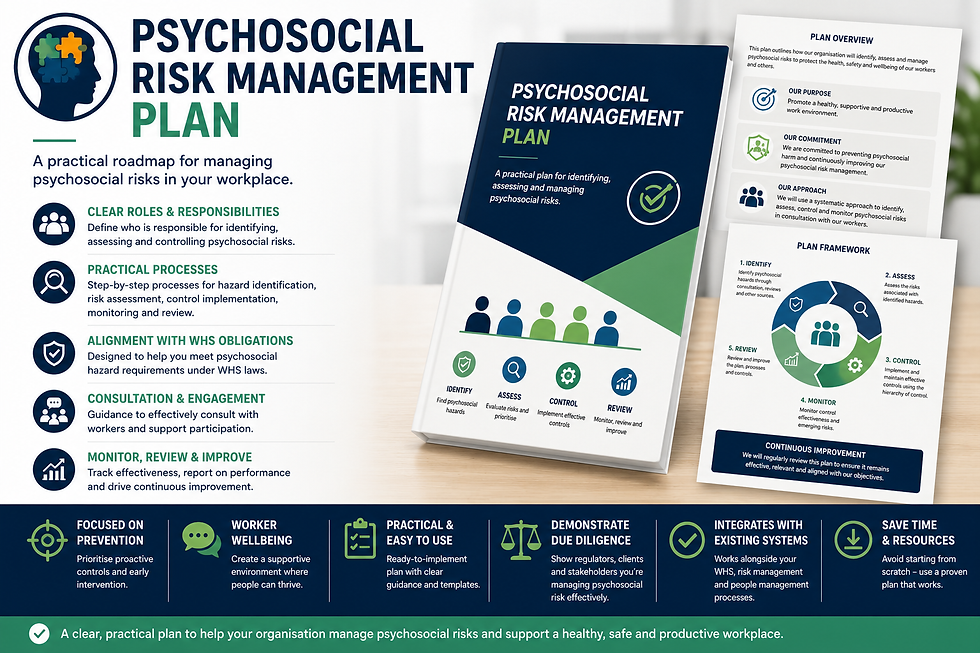
A good psychosocial risk management framework involves a systematic approach that integrates both proactive and reactive measures.


This includes:

  • Risk Identification: Identifying psychosocial hazards through methods such as employee surveys, focus groups, incident reports, and workplace audits.

  • Risk Assessment: Evaluating the likelihood and consequence of identified hazards, considering factors such as work environment, task demands, and organisational culture.

  • Risk Control: Implementing control measures that follow the hierarchy of controls, prioritising elimination, and minimising risks through redesign, policies, training, and awareness programs.

  • Monitoring and Review: Regularly assessing the effectiveness of control measures, capturing feedback from employees, and making continuous improvements.

  • Documentation and Reporting: Ensuring records of risk assessments, control measures, and review processes are maintained and accessible.


A strong framework should be integrated into broader workplace health and safety systems, providing clear accountability, leadership, and communication. It must also involve workers in the consultation process, ensuring that the measures are practical, effective, and culturally appropriate.

Training should be provided to all workers on psychosocial hazards, controls that are in place and other training identified in your risk assessments.

Understanding the Differences: MHFA, PFA and Peer Support

​Unsure what training your workers need?

  • Mental Health First Aid (MHFA): Focuses on recognising the signs and symptoms of mental health issues such as anxiety, depression, psychosis, and substance use disorders. MHFA teaches participants how to provide initial support, guide individuals towards professional help, and respond to mental health crises like suicidal thoughts or panic attacks. It’s structured to address both acute crises and ongoing mental health conditions.

  • Psychological First Aid (PFA): Designed to provide immediate, short-term support in the aftermath of a traumatic event or crisis. PFA focuses on promoting safety, calming individuals, providing information, connecting them to resources, and encouraging coping strategies. It is intended as practical support, not formal counseling or treatment, and is generally used by frontline workers or peers responding to emergencies.

  • Peer Support: Involves providing empathetic, non-professional support to individuals experiencing stress or challenges. It emphasises active listening, emotional support, shared experiences, and practical assistance. Peer Support is ongoing and relationship-based, fostering resilience and connection within teams or communities. Unlike PFA, it is not limited to immediate crisis response but supports individuals through longer-term challenges.

Psychosocial Resources

SRA Global on thinkers360
bottom of page