
A Ticket Is Not a VOC: How to Verify Competence on Your Site
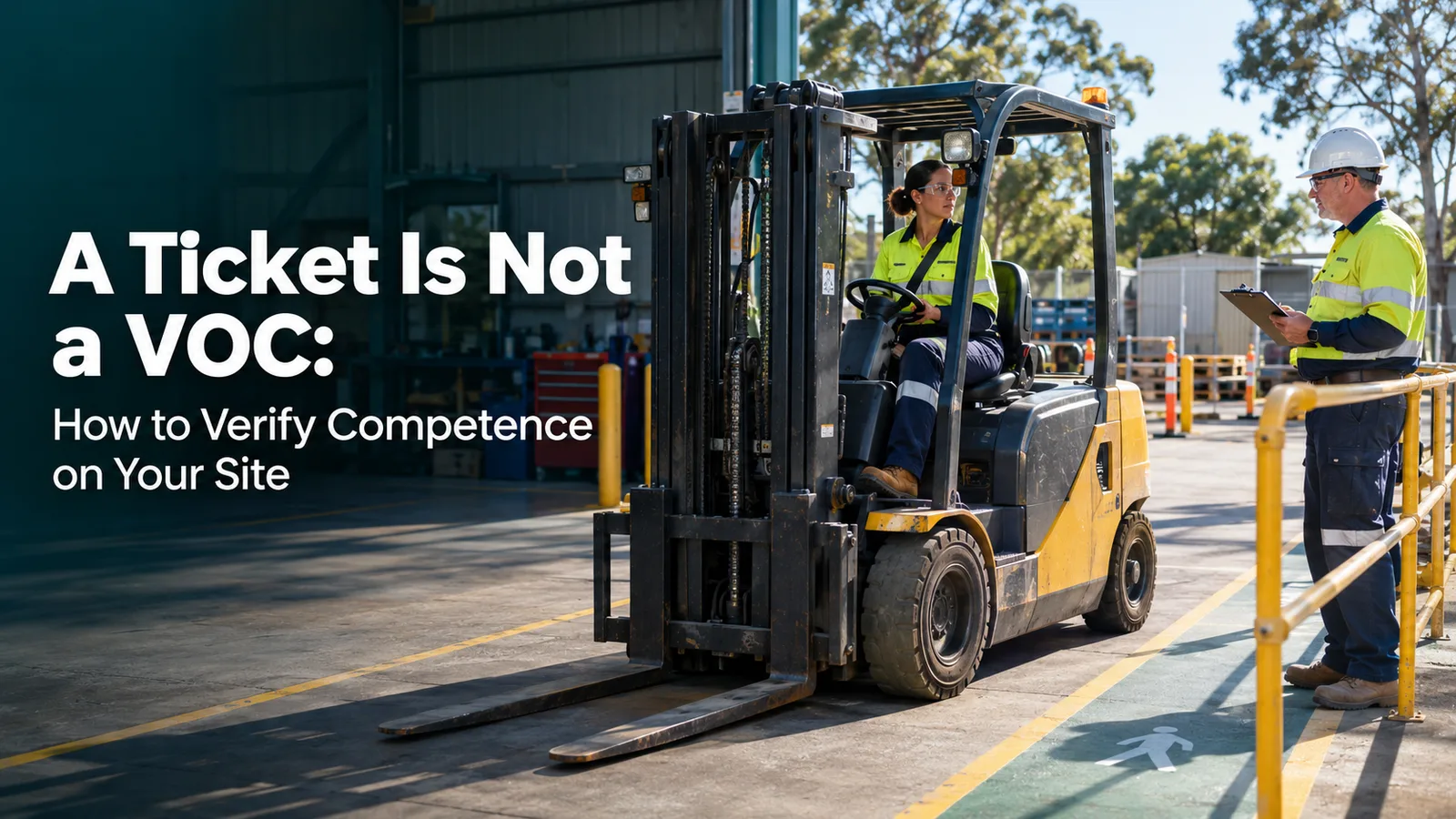
A labour hire operator arrives on Monday with a current forklift licence and five years' experience. By lunchtime he is driving a reach truck in your cold store, lifting pallets to the top beam in a narrow aisle, on a machine he has never used, in a building where pedestrians cross the aisles at the end of every row.
His licence was real. His experience was real. Nobody checked whether he could do this job, on this machine, in this building. That check is a verification of competency (VOC), and it is the step most often skipped.
What a ticket tells you, and what it does not
A licence, ticket or certificate tells you that a person was trained and assessed against a standard, somewhere, at some point. That matters. Where the law requires a licence (in Australia, a high risk work licence), nobody should do the work without one, and a VOC never replaces it.
But a ticket does not tell you:
- whether they have used this make and model, with these attachments
- whether they know your site's traffic rules, exclusion zones and isolation points
- whether their skills are current, or whether they last did the task three years ago
- whether they will follow your procedure, or the habits of their last site
A VOC answers those questions. It is not training and it is not a qualification. It is a structured check that a person can safely do a specific task, with specific equipment, in your workplace, under your conditions.
When you need a VOC
Most businesses only think about VOCs for new starters. The triggers are wider than that:
- a new worker, contractor or labour hire worker, before they work unsupervised
- new or different plant, or new attachments
- a new site, or a big change to the site or the procedure
- after an incident or near miss involving the task
- after time away from the task
- at a set re-verification interval, shorter for higher-risk tasks
Step 1: Set the criteria before you start
A VOC is only as good as the criteria it checks against. Build them from three sources:
- The task risk. What could go wrong, and how badly?
- The critical controls. Which controls must be in place and working every time? On a reach truck, that might be load limits at height, aisle speed, pedestrian exclusion and the pre-start check.
- The procedure. What does your safe work instruction say the job looks like when it is done well?
Then decide your safety-critical fails up front: the few things that stop the VOC on the spot, whatever else went well. Lifting over a person. Bypassing an interlock. Skipping an isolation. Writing these down before you start keeps the decision fair and consistent between verifiers.
Step 2: Gather the evidence
Good verification uses more than one kind of evidence:
- Observation. Watch the person do the real task, start to finish, including the pre-start and the shutdown. Watch what they do, not what they say they would do.
- Questioning. Ask what they would do if something changed: the load shifts, a pedestrian steps into the aisle, the alarm sounds. Good questions test judgement, not memory.
- Records. Check the licence or ticket is current and genuine, and look at any training or previous VOC records.
Then do the three-way check: does what they said, what they did and what is on file line up? If someone describes the exclusion zone perfectly but drives straight through it, the observation wins.
Step 3: Make the call
There are three outcomes, and you should be comfortable using all of them:
- Competent. The person met the criteria. Record it and set the re-verification date.
- Not yet competent. There are gaps, but nothing safety-critical. Decide what closes the gap: more training, a period of supervised work, or a reassessment on a set date. Until then, they do not do the task unsupervised.
- Stopped: safety-critical fail. The VOC ends there. The person does not do the task until they have been retrained and the whole practical has been reassessed.
"Not yet competent" is not a failure of the worker, and it is not a mark against the verifier. It is the system doing its job.
Step 4: Keep records that stand up
After an incident, someone will ask to see the VOC. A record that stands up shows:
- who was verified, on which task and which equipment, on what date, and where
- the criteria they were checked against, and which version of the procedure
- what the verifier observed and asked, not just ticks
- the decision, any follow-up, and the re-verification date
- the verifier's name and signature, and the worker's
A form filled in after the fact, or a column of ticks with no notes, is worse than no record. It suggests the check was never done.
Step 5: Run it as a program, not a one-off
Individual VOCs are only useful if somebody keeps track of them. A simple competency matrix and VOC register (people down the side, tasks across the top, with dates and outcomes) shows at a glance who can do what, whose VOC is due, and where you are relying on one person. Set re-verification intervals by risk, and check a sample of VOC records at your internal audits.
Back to the cold store
With a VOC on Monday morning, the labour hire operator would have spent half an hour with a verifier on the reach truck: pre-start, a few lifts to height, the pedestrian crossings, a couple of "what would you do if" questions. Perhaps he would have been fine. Perhaps he would have needed a day of supervised work first. Either way, you would know, and you would have the record to show it.
Training and documents
Our online course, Verification of Competency (VOC), takes supervisors, assessors and experienced workers through the whole process at their own pace: setting site-specific criteria, gathering evidence, making the decision, keeping records and building a VOC tool for your own tasks. It takes about 2.5 hours and includes a certificate.
Prefer to learn in a room? Our one-day Verification of Competency course runs in Dubbo and in-house, with ongoing support developing your VOC templates. For people who train and assess on the job, see Workplace Trainer and Workplace Assessor.
Documents:
- VOC Program Kit: a VOC procedure, a blank VOC tool for any task, a guide to writing your own, and an Excel competency matrix and VOC register that works out due dates and flags overdue VOCs
- VOC assessment templates for plant and high-risk tasks, each with knowledge questions and a marking guide, an observation checklist, safety-critical fail criteria and sign-off, such as the Forklift VOC Assessment Template, Elevating Work Platform VOC Assessment Template and Hazardous Energy Isolation VOC Assessment Template
- Safety and competency packs that combine a safe work instruction, pre-start checklist, VOC and supervisor field verification checklist, such as the Forklift Safety & Competency Pack
- Training Needs Analysis and Competency Matrix for tracking who can do what
TrainingSupervisionMobile EquipmentWorkplace Health and Safety