
Asbestos Awareness Week: Check Your Register Before Summer Maintenance Starts
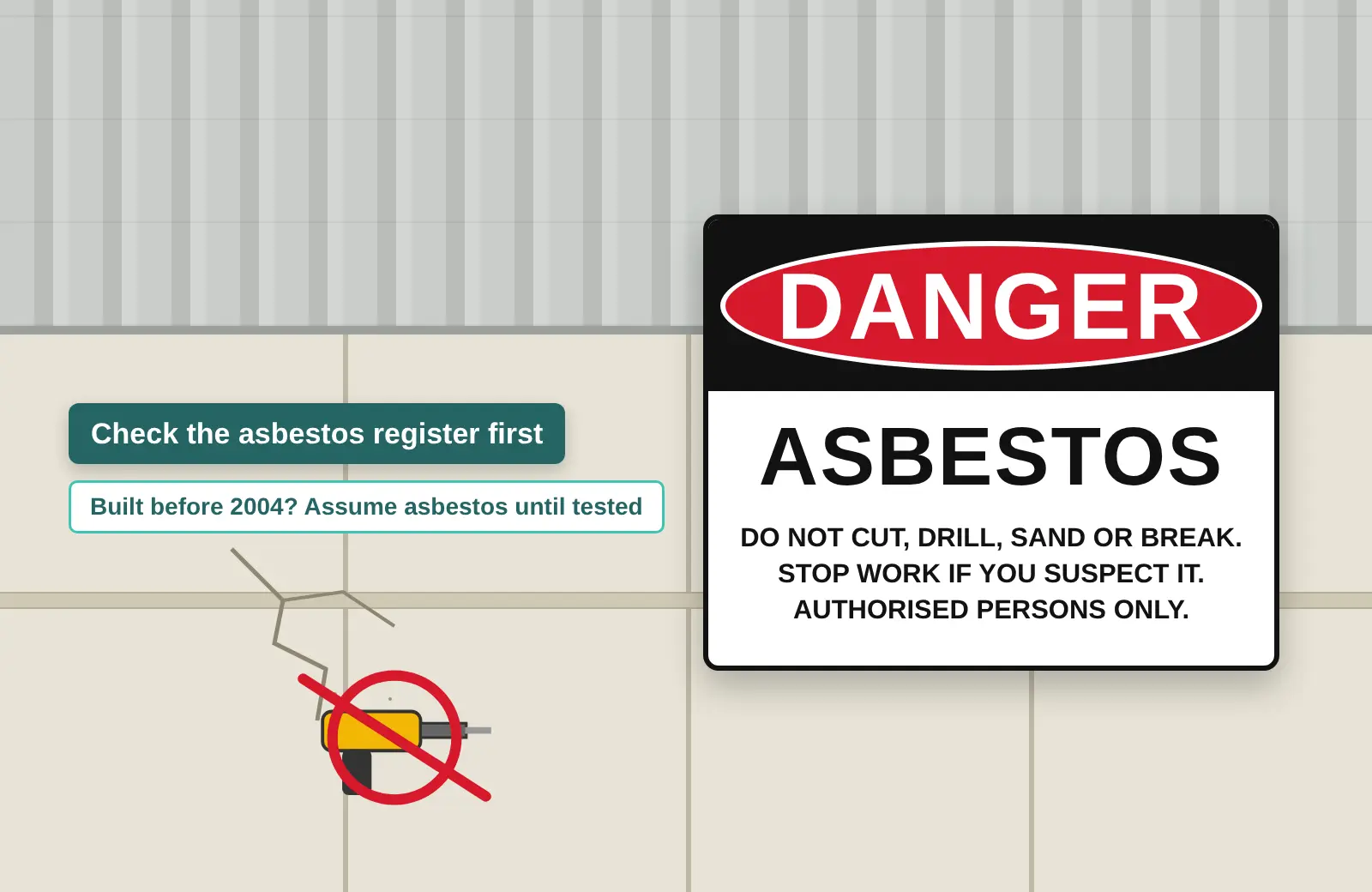
National Asbestos Awareness Week runs in the last week of November, and the timing is no accident. December and January are when many workplaces shut down for maintenance, renovate, rewire and clean up after summer storms. That is exactly the work that disturbs asbestos. If your workplace was built before 31 December 2003, check your asbestos register and your contractor arrangements now, before the work starts.
Why asbestos still matters
Australia banned the use and import of asbestos from 31 December 2003, but it did not remove what was already there. Many workplaces built or renovated before then still contain asbestos-containing materials (ACMs), especially buildings from before 1990.
Asbestos in good condition and left alone is low risk. The danger comes when it is drilled, cut, sanded, broken or crushed, releasing fibres that can be breathed in. Those fibres can cause mesothelioma, asbestosis and lung cancer, usually decades after the exposure. By the time the disease appears, nothing can be done about the day it happened. That is why prevention is the only control that counts.
Where asbestos hides in a workplace
Asbestos was used in thousands of building products. In workplaces, the most common places are:
- Fibro sheeting in walls, eaves, ceilings and outbuildings
- Corrugated cement roofing and gutters
- Vinyl floor tiles and the backing of sheet vinyl
- Under tiles in older bathrooms, kitchens and wet areas
- Electrical switchboard backing panels and meter boards
- Pipe lagging, boiler insulation and old heating systems
- Gaskets, brake linings and clutch plates in older plant and vehicles
- Textured coatings on walls and ceilings
- Fire doors and fire-rated panels
You cannot tell whether a material contains asbestos by looking at it. If it has not been tested, treat it as if it does.
The summer jobs that disturb it
Most asbestos exposures at work are not removal jobs. They happen when someone doing ordinary maintenance does not know asbestos is there. Over summer, watch for:
- Shutdown maintenance: replacing switchboards, running new cabling through walls and ceilings, drilling for brackets
- Renovations and fit-outs: removing floor coverings, cutting into walls, replacing bathrooms and kitchens
- Storm and bushfire clean-up: damaged fibro, roofing and eaves broken by hail, wind or fire
- Roof and gutter work: water blasting, cleaning or replacing old cement roofing
- Demolition of outbuildings: sheds, toilet blocks and carports
Every one of these jobs can be done safely, if the people doing it know what is there before they start.
What your duties are
Under the model WHS laws, a person with management or control of a workplace must manage the risk of asbestos. For a workplace built before 31 December 2003, that means:
- Identify it. Have a competent person find, as far as reasonably practicable, all asbestos and ACMs at the workplace. Anything that cannot be accessed or tested is presumed to contain asbestos.
- Keep an asbestos register. Record where the asbestos is, what type it is and its condition. Keep the register up to date and at the workplace.
- Share the register. Give a copy to anyone who will carry out work that could disturb asbestos, including contractors, before they start.
- Have an asbestos management plan. Set out how the asbestos will be managed, who is responsible, what to do if it is disturbed, and when it will be reviewed.
- Never use the wrong methods. High-pressure water, compressed air and power tools that release fibres must not be used on asbestos except in tightly limited, controlled circumstances. Never water-blast an old cement roof.
- Use the right people for removal. Friable (crumbly) asbestos must be removed by a Class A licensed removalist. Non-friable asbestos over 10 square metres needs a Class A or Class B licensed removalist. Smaller amounts of non-friable asbestos can be removed by a competent person without a licence, but the work must still follow the code of practice.
If you don't have these yet, our editable Asbestos Register Template (Excel, with a contractor sharing and sign-off form) and Asbestos Management Plan Template give you both, ready to fill in.
Work that is likely to involve disturbing asbestos is high risk construction work, so it also needs a safe work method statement (SWMS) before it starts.
Victoria has its own Occupational Health and Safety laws with similar requirements, and some details differ between states and territories. Check your regulator's guidance for the rules where you work.
Before contractors start: a 10-point checklist
Run through this before any maintenance, renovation or clean-up work this summer:
- Was the building built before 31 December 2003? If yes, find your asbestos register.
- Is the register current? When was it last reviewed, and does it cover the area being worked on?
- Has the contractor been given a copy of the register for that area?
- Does the job involve drilling, cutting, sanding or breaking any material that has not been tested?
- If so, has the material been tested, or will it be treated as asbestos?
- Is a SWMS in place for any work likely to disturb asbestos?
- If asbestos needs to be removed, is the right licence class engaged?
- Do the workers know how to recognise likely ACMs and what to do if they find one?
- Is there a clear stop-work rule if suspected asbestos is found?
- Who will update the register when the work is finished?
What to do if asbestos is disturbed
If someone breaks, drills or cuts into something that might contain asbestos:
- Stop work straight away and keep other people out of the area.
- Do not try to clean it up with a broom, a household vacuum cleaner or a hose.
- Tell the supervisor or the person in control of the workplace.
- Get a competent person to assess the area, and a licensed removalist if clean-up is needed.
- Record what happened: who was there, for how long, and what was done. Keep it with your incident records.
- Update the register and the management plan once the area is made safe.
Make this your written procedure, so everyone follows the same steps. The Unexpected Find of Asbestos Procedure sets them out with an incident and exposure record form, and the Asbestos SWMS covers work near known asbestos and small non-friable removal jobs, with their limits stated up front. All four documents come together in the Asbestos Management Pack for $149.
Train the people most likely to find it
The people most at risk are rarely asbestos removalists. They are electricians, plumbers, carpenters, maintenance workers, cleaners and facilities staff who come across asbestos while doing something else. A short awareness session before the summer work starts is one of the simplest controls you can put in place.
- Our free online Asbestos Awareness course takes about 40 minutes and gives a certificate when you finish. It covers where asbestos hides, what it does to the lungs, how to check the register and what to do in the first minutes if it is disturbed.
- For a team session on site, the Asbestos Awareness toolbox talk gives you editable slides, a facilitator guide and an assessment.
- To check your own system, the Asbestos Management Code of Practice Audit Tool and the Asbestos Removal Code of Practice Audit Tool walk you through the codes question by question.
- If asbestos is one of your critical risks, the Silica and Asbestos Exposure Critical Control Verification Pack helps you check in the field that your controls are working.
The bottom line
Asbestos Awareness Week is a good reminder, but the real test comes over summer, when the drills and saws come out. Find your register, share it with every contractor, and make sure the people doing the work know what to look for and when to stop. If you would like help reviewing your asbestos register, management plan or contractor arrangements, contact us.
Health ManagementHealth and Safety LegislationWorkplace Health and Safety