
Falls Are Still Costing NSW Businesses: What the Latest Fines Tell Us
Falls from height and falling objects are among the most common causes of death and serious injury at work in Australia. They are also among the best understood. The controls are well known, the equipment exists, and the codes of practice are clear. Yet the prosecutions keep coming.
Over the past few months, SafeWork NSW has taken a run of businesses to court over falls and falling objects. None of the incidents involved an unusual or unforeseeable hazard. Every one of them involved a control that was missing, not working, or not checked.
What has been before the courts
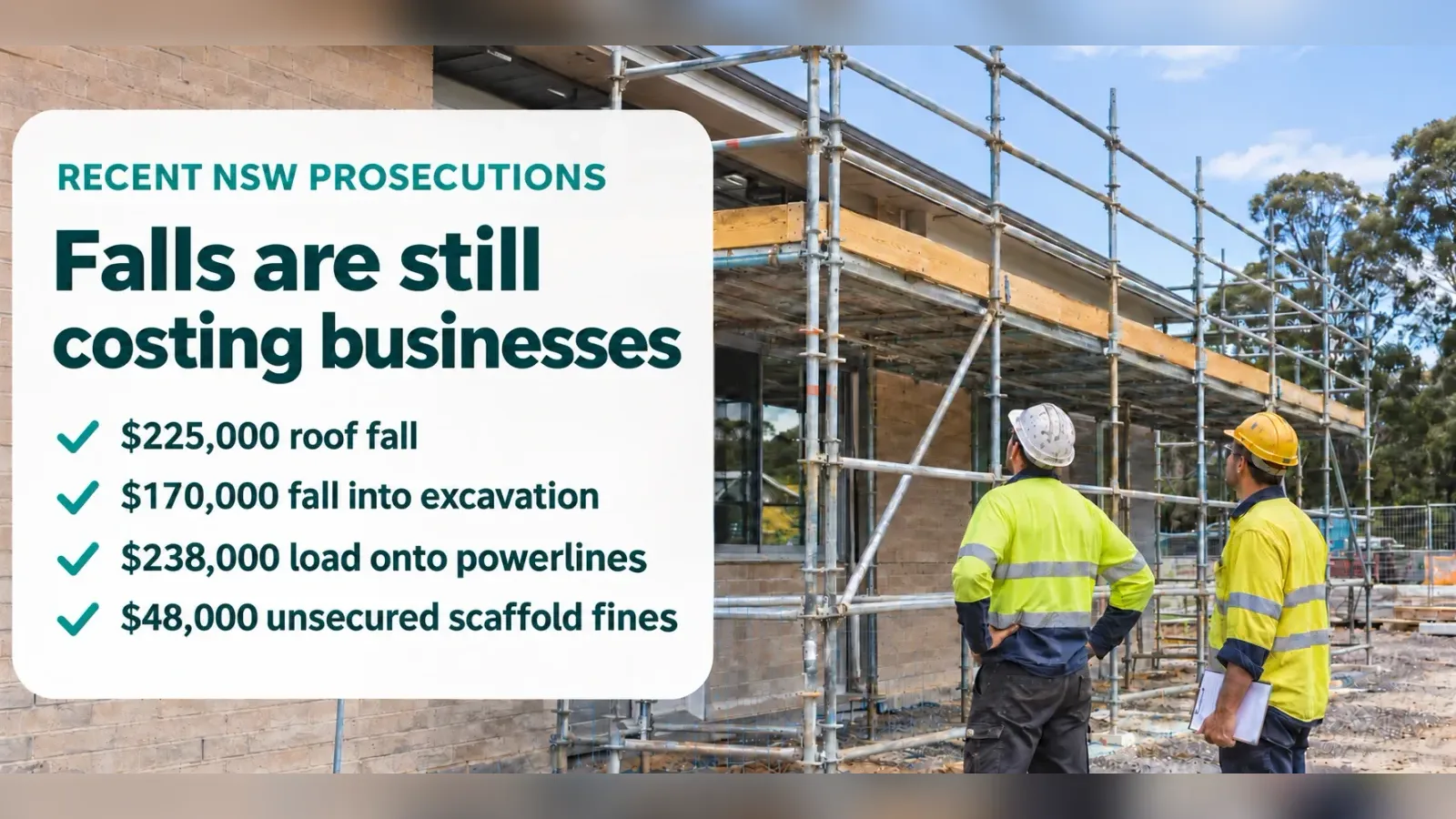
A worker fell nearly 3.8 metres from a house roof. A metal roofing contractor, engaged to help the principal contractor with re-sheeting and cladding on a residential job at Avalon Beach, was fined $225,000 after a worker fell from the roof and was seriously injured. The company pleaded guilty to failing its duty to its workers. SafeWork NSW
A traffic controller fell into an excavation. During a concrete pour, a pump malfunctioned and sprayed concrete unexpectedly. A traffic controller fell into an excavation pit that was about 10 metres deep at its deepest point. The shoring company was fined a total of $170,000 for failing in its duty to both its workers and other people at the site. SafeWork NSW
An unsecured mobile scaffold put the public at risk. Nobody was hurt, but a scaffolding company was fined $40,000 and its sole director a further $8,000 for failing to exercise due diligence. SafeWork NSW
A steel cage fell onto 11,000-volt powerlines. On a construction site at North Wollongong, a 16-metre steel reinforcement cage being guided into a hole buckled and fell onto overhead powerlines. The company was fined $238,000 in the Industrial Court. Safety Solutions
Four lessons from these cases
1. Nobody has to be hurt for you to be prosecuted
The scaffold case had no injury at all. The offence is exposing people to a risk of death or serious injury, not the injury itself. An unsecured scaffold, an open edge or a load near powerlines is a breach before anything goes wrong. That is why checking controls before the work starts matters more than investigating after it.
2. Directors are personally in the frame
The scaffold company's sole director was fined separately for failing to exercise due diligence. Officers must take reasonable steps to understand the hazards of the business, make sure there are resources and processes to control them, and verify those processes are used. "I didn't know the scaffold wasn't secured" is not a defence if there was no way for the director to know.
3. Other people's risks are your risks too
In the excavation case, the person who fell was a traffic controller, not one of the shoring company's own workers, and the company was convicted for failing in its duty to other people as well as its workers. Edges, pits and lifting zones need to be controlled for everyone on or near the site: subcontractors, visitors, delivery drivers and members of the public.
4. These cases take years, and so does the damage
Each of these incidents happened about four years before the fine. For four years the businesses carried the investigation, legal costs, management time and uncertainty, on top of the harm to the people involved. The fine is only the visible part of the cost.
The controls that would have made the difference
Falls are a critical risk: one where a single failure can kill. The controls are well known. What fails is usually the checking.
For work at height
- Eliminate the need to work at height where you can: prefabricate on the ground, use extendable tools, and plan the job so less work happens at the edge.
- Use edge protection, guardrails, scaffolds or elevating work platforms before relying on harnesses.
- Make sure scaffolds and mobile scaffolds are erected, secured and inspected by competent people, with castors locked and the scaffold tagged before use.
- For roof work, check edge protection, brittle or fragile roofing and skylights before anyone goes up.
For excavations and open edges
- Barricade, cover or fence excavations, and keep exclusion zones around pours and plant.
- Plan for the unexpected, such as a pump failure, and keep people out of the line of fire and away from unprotected edges.
For lifting and falling objects
- Use a lift plan for anything heavier or larger than routine, including how the load could fail or move.
- Identify overhead powerlines before work starts, apply the safe approach distances, and use spotters where needed.
- Keep people out of the drop zone.
For everyone
- Write a safe work method statement for high risk construction work, and check that what is happening on site matches it.
- Verify the critical controls in the field, not only on paper. A supervisor walking the job and checking the edge protection is in place, the scaffold is tagged and the exclusion zone is set does more than any form in the office.
Get the documents and training
Our editable, risk-based documents put these controls into a working system:
- Elevating Work Platform Safety and Competency Pack and Mobile Scaffold Safety and Competency Pack: safe work instructions, competency checks, pre-start checks and field verification
- Crane and Lifting Operations Pack: lift plan, pre-lift checklist and verification of lifting controls
- SWMS Template, with a worked example and sign-on sheet
- Critical Control Verification Packs: a bowtie and a field verification form for falls, dropped objects and other critical risks
- Officers' Due Diligence Checklist for directors and senior managers
To brief your team, the Working at Heights and Dropped Objects toolbox talks are ready-to-run 20 to 30 minute sessions. Workers can also complete our free Working at Heights Awareness online course, and we run nationally recognised Working at Heights (RIIWHS204E) training.
If you would like your fall controls reviewed before the busy end-of-year period, contact us.
This article is general information based on SafeWork NSW media releases and published reports. Each company named has the right to appeal. It is not legal advice.