How to Run a Toolbox Talk That Actually Works
Most workplaces run toolbox talks. Far fewer get much out of them.
You will recognise the bad version: a supervisor reads a page aloud while the crew looks at their boots, everyone signs the sheet, and the work starts exactly as it would have anyway. The sheet goes in a folder as proof that "safety was discussed". Nothing changed.
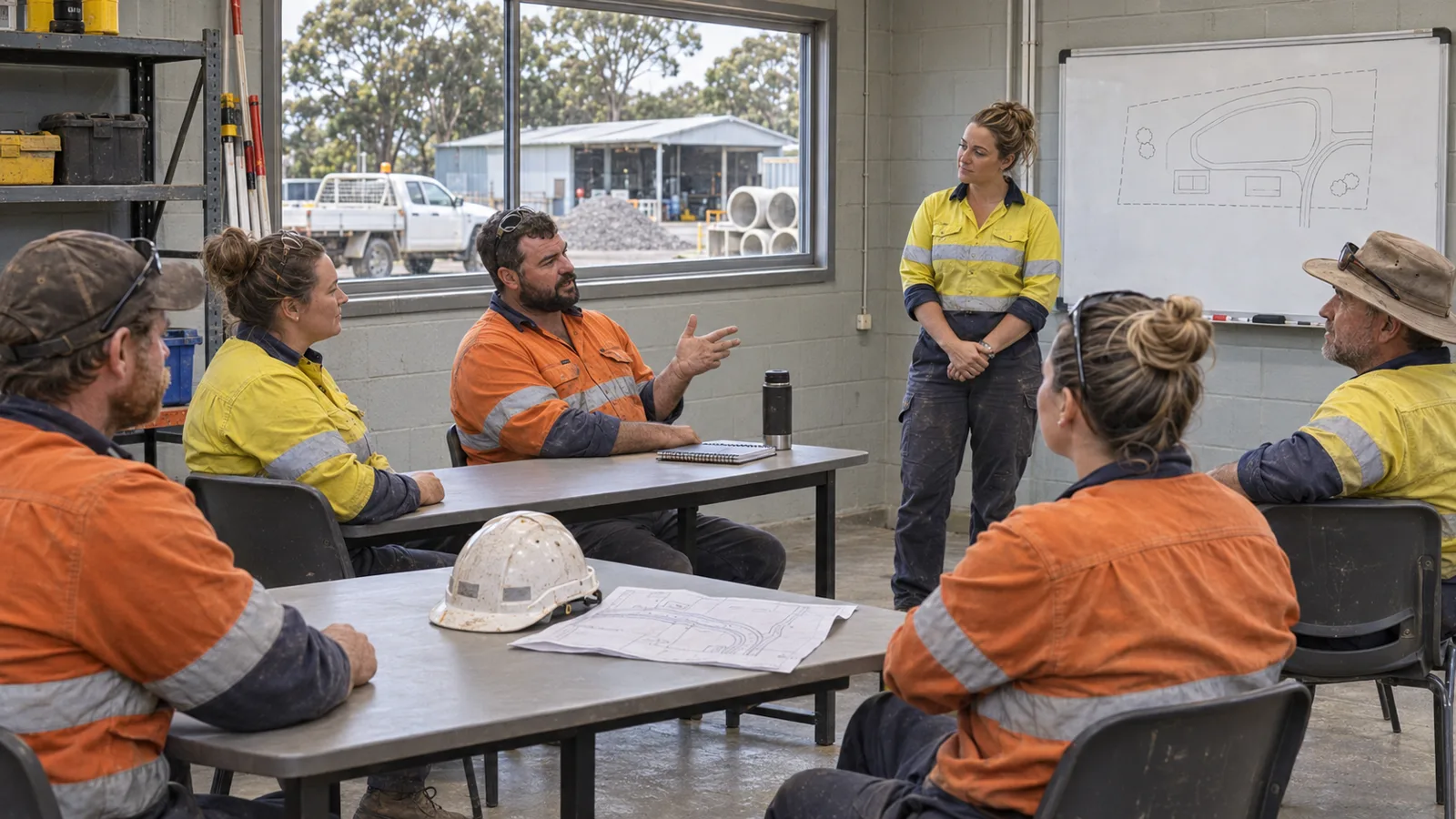
A good toolbox talk takes the same 15 minutes and does something useful: it gets the people doing the work talking about how the work could hurt them, and what would stop it. Here is how to run one.
1. Pick one topic, and make it today's
The best toolbox talk is about the work the crew is about to do. If they are working at heights this week, talk about the ladder, the platform and the edge they will be near. If a near miss happened yesterday, talk about that.
One topic only. A talk that covers fatigue, PPE, the new forklift and the Christmas party covers none of them.
2. Start with something real
People switch off for general statements ("falls are a major cause of injury") and switch on for things they recognise. Open with a specific example:
- a near miss or hazard report from your own site, without names
- a photo of a real job, such as this morning's work area
- a short "what's wrong here?" scene
- a change to the job, the equipment or the crew
Composite examples work too. What matters is that the crew can picture it happening to them.
3. Ask, then listen
The most important part of a toolbox talk is the question, not the presentation. Ask something that only the crew can answer:
- "Where on this job could someone fall?"
- "What would make you skip that step?"
- "What's the hardest part of doing this the way the procedure says?"
- "If this control wasn't there, what would happen?"
Then stop talking. The gap between how a job is written down and how it is actually done (work as imagined and work as done) is where people get hurt, and the crew knows exactly where that gap is. A toolbox talk is one of the few times you can hear about it before an incident does it for you.
4. Talk about controls, not just hazards
Naming hazards is the easy part. Spend most of the time on what stops the hazard hurting someone, starting at the top of the hierarchy of control: can we remove it, swap it, separate people from it, or engineer it out, before we rely on procedures and PPE?
Use one simple test for every control the crew mentions: a control must change the risk, and someone must be able to check it. "Be careful" fails that test. "The exclusion zone is barricaded and the spotter checks it before the lift" passes it.
5. Agree what happens next
Finish with something concrete. Who is doing what, by when? If the crew raised a problem, such as a missing guard, a ladder that should be tagged out, or a procedure that cannot be followed as written, say who will fix it and when they will hear back. Then make sure they do.
Nothing kills toolbox talks faster than workers raising the same issue three weeks running and nothing happening. Acting on what they tell you is also part of genuine consultation, which WHS and OHS laws require.
6. Keep a record that means something
Record who attended, the date, the topic and any issues raised and actions agreed. If your business wants evidence that workers understood the key points, add a short quiz.
But remember what the record is: proof that a conversation happened, not proof that the risk is controlled. A signed attendance sheet is not a control.
7. Keep it short and regular
Fifteen to twenty minutes, at the start of the shift or the job, close to the work. Weekly or fortnightly works better than a long session every few months. Rotate who leads it: a worker explaining a hazard they deal with every day is often more convincing than a supervisor reading from a page.
A quick checklist
- One topic, linked to today's work
- A real example to open
- At least one open question, and time to answer it
- Controls discussed from the top of the hierarchy down
- Actions agreed, with a name and a date
- Issues raised followed up and reported back
- Attendance recorded, with an optional quiz
Ready-to-run toolbox talks
If preparing a good toolbox talk every week is the hard part, we have done it for you. Our toolbox talk packages cover 28 common hazards, from working at heights and mobile equipment to fatigue and workplace bullying. Each one is a 20 to 30 minute session with:
- editable slides with speaker notes
- a facilitator guide with the questions to ask and model answers
- a one-page handout
- an attendance record in Word and Excel
- an optional 10-question multiple-choice assessment, and a certificate
They are $49 + GST each, or get all 28 in the Toolbox Talk Complete Library. For new starters and contractors, our customisable Workplace Health and Safety Induction covers the essentials in one session.
This article is general information, not legal advice.
Safety CultureWHS Consultation BlogTrainingWorkplace Health and Safety