
Which Incident Investigation Method Should I Use? Simple Reporting, 5 Whys or ICAM
After an incident, the question is usually not whether to investigate but how much. Put a full investigation team on every cut finger and you will drown in paperwork and nobody will report anything. Treat a serious near miss as a quick form and you will miss what nearly killed someone.
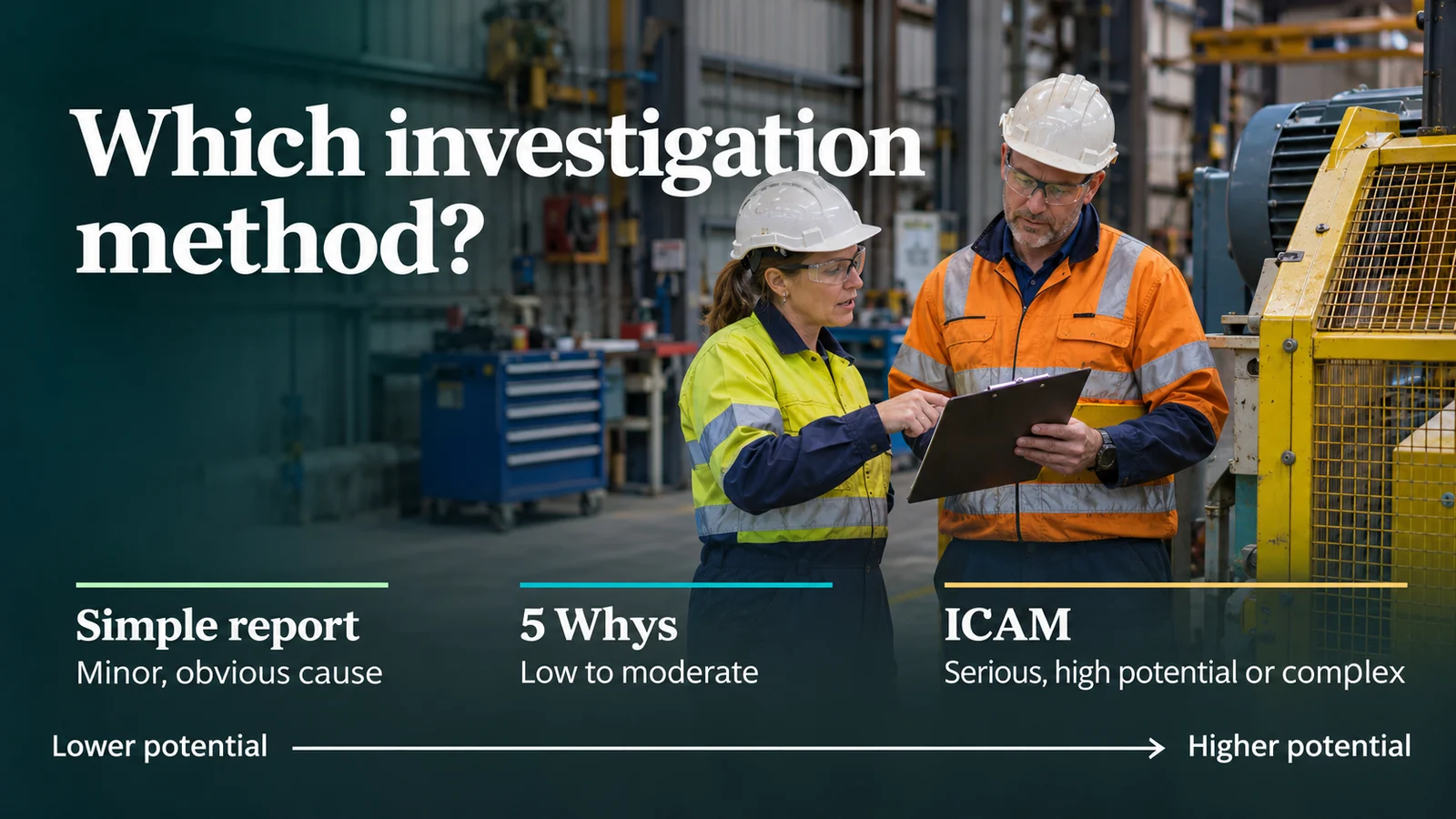
The answer is to match the method to the event. For most workplaces, three levels cover almost everything: simple reporting, 5 Whys and ICAM.
Start with the potential, not just the outcome
The most important question is not "how bad was it?" but "how bad could it have been?"
A dropped spanner that missed someone by a metre caused no injury. But if it fell from height into a walkway, it could have killed someone. That potential, not the lucky outcome, should decide how deeply you look.
Ask:
- What was the actual outcome? No injury, first aid, medical treatment, lost time, serious injury.
- What was the worst realistic outcome? If things had been slightly different, could someone have been seriously hurt or killed?
- How complex is it? Is the cause obvious, or are there several people, tasks, contractors or systems involved?
- Has it happened before? A repeat of a "minor" event is a signal that something in the system is not working.
Level 1: Simple reporting
For: minor events with low potential, where the cause is obvious and the fix is simple.
A simple report records what happened, the immediate cause, what was done about it and who needs to know. It should take minutes, not hours. The aim is to keep the information flowing, fix the obvious problem and spot trends over time.
Examples:
- A worker gets a small cut opening a box with a knife. First aid only. The fix is a safety knife, and a reminder to the team.
- Someone slips on a wet floor near the tearoom sink with no injury. The tap is leaking. Raise a maintenance job, put down a mat, and record it.
- A hazard report that a step on the mezzanine stairs is loose. Barricade it, fix it, close it out.
- A delivery driver reverses into a bollard in the car park at low speed. Minor damage, nobody nearby. Record it and check whether the bollard needs marking.
Watch for: a run of similar simple reports. Five "minor" slips in the same spot is not five minor events. It is one problem that needs a proper look.
Level 2: 5 Whys
For: low to moderate events where you want to get past the immediate cause, but the event is not complex or high-potential.
5 Whys is a simple questioning technique. You start with what happened and ask "why?" repeatedly, usually about five times, until you reach something the business can actually fix. It works well as a quick conversation with the people involved, and it encourages reflection rather than blame.
A worked example: a forklift clipped a racking upright in the warehouse. No injury, minor damage.
- Why did the forklift hit the racking? The operator turned into the aisle too tightly.
- Why did they turn too tightly? A pallet was left on the floor at the end of the aisle, narrowing the turn.
- Why was a pallet on the floor? The receiving area was full, so pallets were being staged in the aisles.
- Why was the receiving area full? Two deliveries arrived on the same morning.
- Why did two deliveries arrive together? Deliveries are not booked into time slots.
The fix is not "operator to take more care". It is booked delivery slots, a marked overflow area, and keeping aisle ends clear.
Other good uses:
- A machine guard was found left off after a cleaning task.
- A chemical drum was found leaking in the store with no exposure.
- A ute and a pedestrian had a near miss in a depot yard at low speed.
- A worker strained their back lifting a box that was heavier than labelled.
Watch for these traps:
- Stopping at the person. If your last "why" is "because they didn't follow the procedure", keep going. Why didn't they? Could they?
- Only following one line. Most events have more than one cause. If you hit a fork, follow both branches.
- Using it for serious events. 5 Whys is too simple to untangle a complex or high-potential incident. That needs a structured method.
Level 3: ICAM
For: serious incidents, high-potential near misses and complex events, where the consequences were, or could have been, severe.
ICAM (Incident Cause Analysis Method) is a structured, systems-based investigation method drawing on the work of Professor James Reason. Instead of focusing on what one person did, it looks at the whole system, working through:
- Absent or failed defences: the controls that should have stopped the event, or reduced its consequences, and why they were missing or did not work.
- Individual and team actions: what people did or did not do immediately before the event, without stopping there.
- Task and environmental conditions: what was happening on the job at the time, such as workload, time pressure, equipment, layout, weather or lighting.
- Organisational factors: the decisions, systems, resourcing, training, planning and culture that created those conditions.
An ICAM investigation is usually led by a trained investigator with a small team, uses evidence from interviews, the scene, documents and records, and ends with recommendations that target the system, not just the individual.
Examples:
- A maintenance fitter's hand is caught in a conveyor during a breakdown repair. The isolation was not applied as planned.
- A crane load is dropped into an exclusion zone while a worker is walking past. Nobody is hurt, but the potential was fatal.
- A light vehicle rolls on a site access road, injuring the driver.
- A trench wall collapses minutes after workers climbed out of it.
- A contractor receives an electric shock while working on equipment that was thought to be de-energised.
- The same critical control has failed several times in the past year.
Notifiable incidents and high-potential near misses are where ICAM earns its keep. They are also the events where you most need the investigation to stand up to scrutiny from the regulator, your board and the families of the people involved.
A quick guide
| The event | Method |
|---|---|
| Minor event, low potential, cause obvious | Simple report |
| Low to moderate event, or repeat minor events, cause not obvious | 5 Whys |
| Serious injury, notifiable incident, or high-potential near miss | ICAM |
| Complex event involving several people, contractors or systems | ICAM |
| A critical control has failed | ICAM |
Whatever the method, the basics are the same: make the scene safe, look after the people involved, preserve the evidence, talk to people fairly, look past the individual to the conditions, and make sure the corrective actions actually happen.
Putting it into your system: an investigation matrix
Writing the levels down means nobody has to decide on the day how much investigation an incident deserves. A simple matrix like the one below sets the method, who leads, who is involved, how long it takes and who signs off the actions for each level. The dollar values and timeframes are examples: set them to suit the size of your business.
| Level 1: Low | Level 2: Medium | Level 3: High | Level 4: Extreme | |
|---|---|---|---|---|
| Severity | Minor | Moderate | Major | Extreme |
| Incident type |
|
|
|
|
| Investigation level | Simple report | Simple report and 5 Whys | Formal investigation (ICAM) | External investigation |
| Lead investigator | Supervisor | Manager | Trained ICAM investigator | Independent external investigator |
| Investigation team |
|
|
|
|
| Timeframe to complete | 5 business days | 5 business days | 14 business days | 30 business days |
| Action plan approved by | Manager | WHS adviser | Senior manager responsible for WHS and people, with the return to work coordinator | Chief executive or business owner |
| Communication | Shared with the team at the next toolbox talk | Incident alert from the WHS team | Lessons learned shared by the senior manager responsible for WHS | Lessons learned shared by the chief executive or business owner |
In a small business, several of these roles may be the same person. That is fine. What matters is that the level, the lead and the deadline are decided before the incident, not after.
ICAM training with Orana Skills Centre
Orana Skills Centre are licensed ICAM facilitators. We run the ICAM Lead Investigator course face to face at our Dubbo training centre, in partnership with Safety Wise (RTO 21871), with an optional assessment for the nationally recognised unit BSBWHS515 Lead initial response to and investigate WHS incidents. The next public course is on 23 and 24 February 2027 in Dubbo. See the dates and book.
See our incident investigation training page for how we can help your team build investigation capability, including in-house training using your own incidents as examples.
Just had an incident? Our free Incident Response Checklist walks you through the first hours and days: the steps, the notifications, the evidence to collect and the people to talk to.
For supervisors, our online course Frontline Supervisor: Leading Work Safely covers the first hour after an incident, gathering evidence, interviewing witnesses fairly and writing corrective actions that work.
Documents:
- Incident Report and Investigation Form: for simple reports and 5 Whys investigations
- Notifiable Incident Procedure: who decides, who calls the regulator and how the scene is kept after a serious incident
Incident InvestigationIncident ResponseWorkplace Health and Safety