
Working in Heat This Summer: What Employers Need in Place Before 1 December
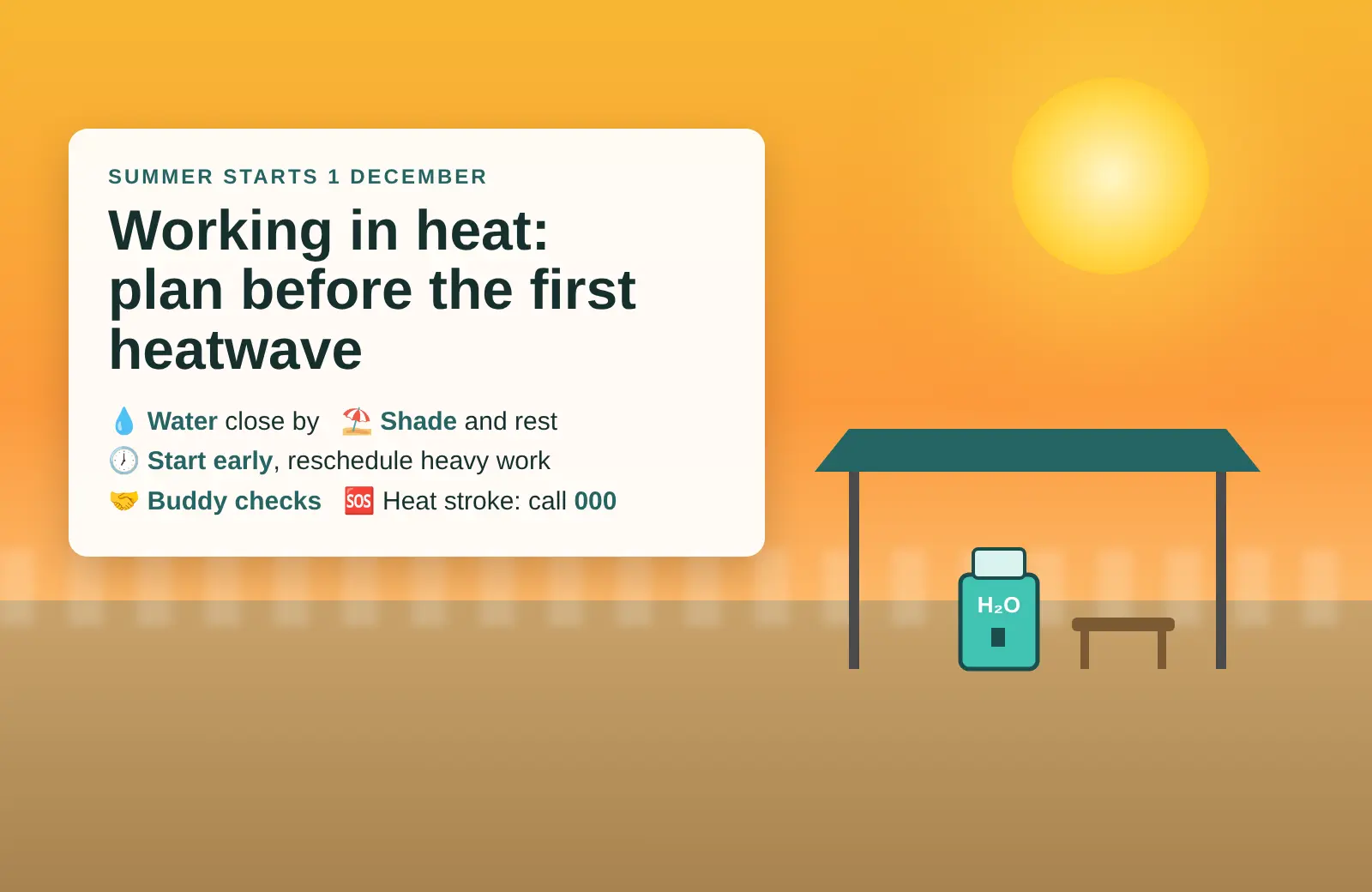
Summer starts on 1 December, and Safe Work Australia is now developing a national strategy on how climate change affects work health and safety. Heat is no longer a few bad days a year. For outdoor crews, farm workers, kitchens, warehouses and early childhood educators, it is a hazard to plan for every summer. The time to set up your heat plan is now, before the first heatwave, not on the day of it.
Heat is a WHS hazard like any other
Employers have the same duty for heat as for any other hazard: identify it, assess the risk, and control it so far as is reasonably practicable. That includes heat from the weather, and heat from the work itself: hot plant, kitchens, roofs, enclosed spaces, heavy physical work and protective clothing that traps heat.
Heat illness can start with tiredness, headache, cramps and dizziness, and progress to heat stroke, which is a medical emergency. Heat also causes other incidents: tired, dehydrated workers make mistakes, sweaty hands slip, and judgement suffers.
Decide your trigger levels now
The most useful thing you can do before summer is decide, in advance, what you will do as it gets hotter. If you wait until it is 40 degrees, the decision gets made under pressure, and work usually just carries on.
Set your own trigger levels for your work, using the Bureau of Meteorology's heat warnings and Safe Work Australia's guidance on working in heat, and write down the action at each level. For example:
- Warm days: extra water at every work area, more frequent short breaks, shade set up.
- Hot days: heavy and outdoor work moved to the cooler parts of the day, longer breaks in a cool area, buddy checks.
- Very hot days or heatwave warnings: heavy work rescheduled, outdoor work reduced to what is essential.
- Extreme heat: non-essential outdoor work stopped.
The right triggers depend on the work, the environment and your people. A crew laying bitumen in full PPE needs earlier triggers than a team doing light work in the shade.
The controls that make the difference
- Water: cool drinking water close to every work area, and the time to drink it. Small amounts often are better than a lot at once.
- Shade and cool-down areas: somewhere out of the sun, with airflow, where workers can actually rest.
- Scheduling: start earlier, move heavy jobs to the cooler parts of the day, and rotate tasks.
- Rest breaks: more often as it gets hotter, and taken in the shade, not on the job.
- Clothing and PPE: light, breathable clothing where it is safe, and plan for the heat that PPE adds.
- Buddy checks: workers keep an eye on each other, because people with heat illness often don't notice their own symptoms.
- Self-pacing: let workers slow down when they need to, without pressure.
New and returning workers need time to adjust
People who are not used to working in heat are at much higher risk in their first days. That includes new starters, workers returning from leave or illness, and anyone back from cooler places. Build their time in the heat up gradually over the first week, check in with them every day, and make sure they know the signs to stop.
Hydration: what you can and can't do
A urine colour chart in the toilets and crib rooms is a simple, practical self-check, and a water and rest log helps supervisors keep track on hot days. Formal hydration testing, such as urine specific gravity tests, is different: it is health monitoring, and it needs the worker's consent, privacy controls and an occupational health provider. If you want it, use a provider rather than doing it yourself.
If someone gets heat illness
- Stop work and move them to shade or a cool area.
- Cool them down with water, fans or cold packs, and loosen tight clothing.
- Give sips of water if they are conscious and able to drink.
- Call triple zero (000) if they are confused, collapse, stop sweating or are getting worse. Heat stroke is a medical emergency.
- Never leave them alone.
Make sure your first aiders know this, and that your first aid kits and emergency plan cover heat illness at your sites.
Your heat checklist for the next two weeks
- Run a heat stress risk assessment for your hot jobs and hot workplaces.
- Decide your trigger levels and the action at each one, and tell your workers.
- Check water, shade and cool-down areas at every site.
- Plan acclimatisation for new and returning workers.
- Put up a hydration self-check poster and give supervisors a hot day checklist.
- Brief your crews with a toolbox talk on working in heat.
- Check your first aid arrangements and emergency plan cover heat illness.
Get the documents
Our new Heat Stress Management Pack gives you all of this, ready to edit:
- Heat Stress Management Procedure, with a trigger table you set for your work
- Heat Stress Risk Assessment, with an Excel register
- Acclimatisation Plan for new and returning workers
- Hot Day Supervisor Checklist and Hydration Log
- Hydration Self-Check Poster and Heat Illness First Aid Card
To brief your team, the Working in Heat Awareness toolbox talk is a ready-to-run 20 to 30 minute session. Farms can also use the Farm WHS Pack, and early learning services the Early Childhood Education and Care WHS Pack, which includes a sun and heat procedure for staff.
If you would like help with your heat plan, or first aid training for your team before summer, contact us.