
Planning a Christmas Shutdown? Your Contractor Safety Checklist
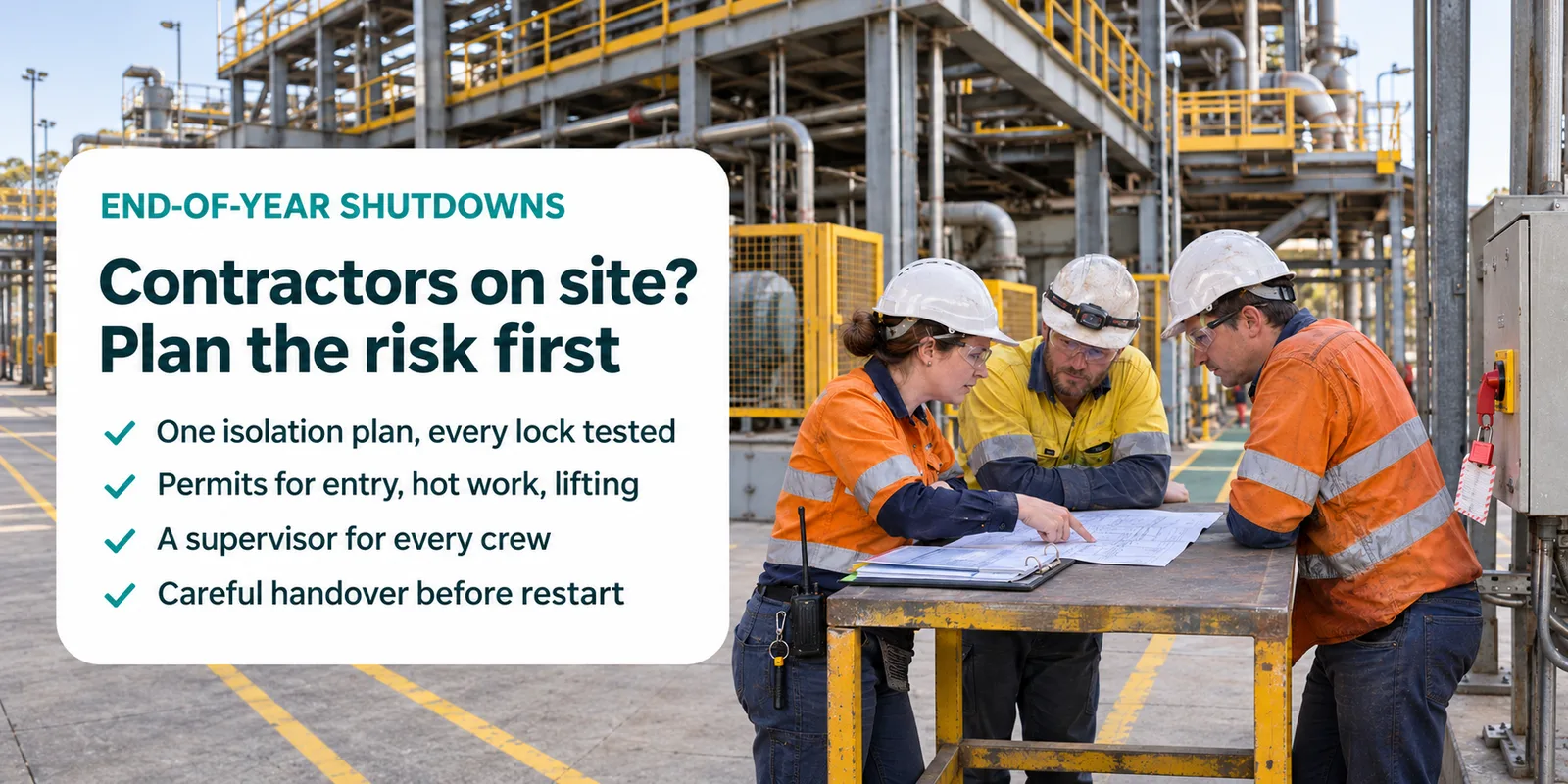
For many sites, the weeks around Christmas are the busiest of the year for maintenance. Production stops, so the work that cannot be done while plant is running gets done all at once: overhauls, tie-ins, inspections, cleaning, painting and repairs. That usually means more contractors on site than at any other time, much of the work high risk, all of it on a tight deadline, while many of your own people are on leave.
Shutdowns are planned months ahead for cost and schedule. The safety planning often starts much later. If your shutdown is in December or January, now is the time to get the risk under control, before the contractors arrive.
Why shutdowns go wrong
The same pattern turns up in incident investigations again and again. It is rarely a single failure. It is a combination of conditions that are all normal during a shutdown:
- Many contractors, many companies. Several crews who have never worked together, or on your site, working side by side.
- High-risk work at the same time. Isolation, confined space entry, hot work, lifting and work at height, often in the same area.
- Time pressure. Every day offline costs money, so the schedule is tight and jobs get squeezed.
- Thin supervision. Your experienced people are stretched across more jobs, or away on leave.
- Plant that is not in its normal state. Partly isolated, drained, opened up or temporarily modified.
- Fatigue. Long shifts, extra days and hot weather.
None of these is unusual on its own. Together they create the conditions for serious incidents.
Your duty does not stop at the contract
Under WHS law, you and your contractors share duties for the same work. Each business must meet its own duty, and you must consult, cooperate and coordinate with each other. Hiring a contractor does not hand the risk over. You still need to know who is on site, what they are doing, how the risk is controlled and whether the controls are working.
That is why contractor management is a leadership job, not just a purchasing or paperwork step.
The shutdown checklist
Six to eight weeks out
- Lock in the scope. List every job, where it is, who will do it and what high-risk work it involves. Late scope changes are where risk gets missed.
- Pick contractors on safety, not just price. Check their safety systems, competencies, licences, insurance and incident history before you sign, not on the first morning.
- Map the overlaps. Mark which jobs share an area, share plant or depend on the same isolation. Two crews working on either side of the same isolation point need one plan, not two.
- Identify the critical risks. For each job, name what could kill or seriously injure someone, and the critical controls that must be in place.
Two to four weeks out
- Plan isolations properly. One isolation plan for the whole shutdown, with clear ownership of every isolation point, personal locks for every worker and a process for proving the energy is dead.
- Set up your permits. Confined space, hot work and work at height permits, with someone trained to issue and close each one. Decide who signs off when jobs overlap.
- Check SWMS and work plans. Read them. A generic SWMS that does not match your site or the task is a warning sign, not a control.
- Plan supervision. Name a supervisor for every crew and every critical task. Make sure the number of jobs each supervisor covers is realistic.
- Plan for fatigue and heat. Shift lengths, breaks, rest days, water and shade, especially for work in enclosed spaces and on roofs.
The first day
- Induct everyone. Site rules, emergency arrangements, isolation and permit rules, and how to raise a concern or stop the job. Contractors who have never been on your site need more than a sign-in sheet.
- Run a coordination meeting. All crew leaders, every morning: what is happening where today, which permits and isolations are live, and what has changed.
During the shutdown
- Verify, do not assume. Supervisors walk the work and check the critical controls are actually in place: isolations locked and tested, gas tested before entry, fire watch posted, exclusion zones set.
- Manage changes. When the scope changes or the plan does not work, stop and reassess before carrying on. Changes made on the run are where controls get lost.
- Keep stop-work authority real. Make sure contractors know they can stop a job without being blamed for the delay.
Handover
- Hand back carefully. Every isolation removed only by the person who applied it, guards back on, permits closed, and the plant checked before restart. Many incidents happen at restart, not during the work.
- Review it. What went well, what nearly went wrong, and what to change next time, while it is still fresh.
The leadership gap
Most of the controls above already exist on paper at most sites. What makes the difference is the people leading the work: supervisors and managers who understand how their own decisions about contractors, schedules and oversight shape the risk, and who are willing to slow a job down when the controls are not right.
Module 3 of our online Risk-Based Leadership™ program, Contractor Management and Project Risk, covers exactly this: the duty you owe to people who do not work for you, and how leaders' oversight decisions affect contractor safety and project outcomes. It is self-paced, so your supervisors can complete it before the shutdown starts. The full online program covers all six modules, including managing change.
Get the documents
Our editable, risk-based documents put the checklist above into a working system:
- Contractor Management Plan: every contract tiered by its risk, with the tools to plan, engage, deliver and evaluate contracted work
- Project Management Plan: the gates, registers and reviews for planning and delivering the work
- Hazardous Energy Isolation Pack, Confined Space Entry Pack, Hot Work Pack and Crane and Lifting Operations Pack: permits, records, competency checks and field verification for the high-risk work
- Workplace Health and Safety Induction: a ready-made induction you can tailor for contractors
To brief crews in person, the Isolation and Lockout Awareness toolbox talk is a ready-to-run 20 to 30 minute session.
If you would like help planning your shutdown, or a review of your contractor management before the work starts, contact us.