
Complying with the First Aid Code of Practice: A Risk-Based Approach
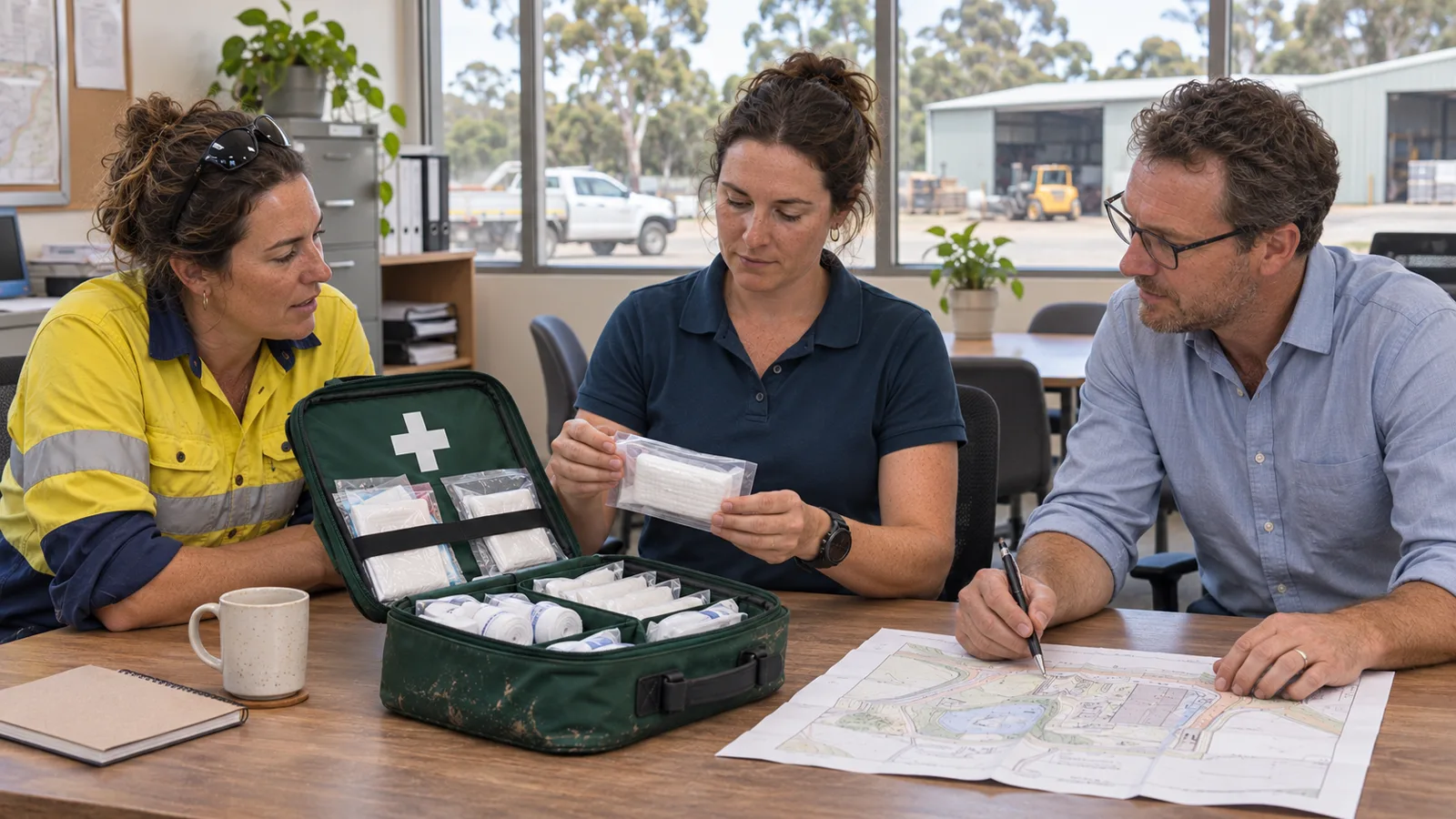
Ask most businesses how they manage first aid and you will hear about the kit in the lunchroom and the person who did a course a few years ago. That is a start. It is not what the code of practice asks for.
The Code of Practice: First aid in the workplace is built on one idea: first aid is planned around the risks at your workplace. A small office and a remote mine site have very different needs, and the code expects each to work out its own. In NSW, where approved codes of practice became binding on 1 July 2026, that plan now needs to meet the code or an equivalent or higher standard (more on that change here).
What the law requires
Under the WHS Regulations, a person conducting a business or undertaking must make sure that:
- first aid equipment is provided, and every worker can access it
- each worker can access facilities for administering first aid
- an adequate number of workers are trained to administer first aid, or workers have access to an adequate number of other people who are trained.
The key word is adequate, and the code explains that what is adequate depends on your risks. Victoria, under its own OHS laws, has a compliance code on first aid that takes a similar risk-based approach.
Start with what could foreseeably happen
The code asks you to assess your first aid needs by thinking through the injuries and illnesses that could foreseeably occur, and the time it would take to get help. Consider:
- the nature of the work and its hazards: machinery, vehicles, chemicals, heights, electricity, heat, manual tasks, violence
- the size and layout of the workplace, and how far people are from first aid equipment and from each other
- the number and composition of workers and others, including shift workers, contractors and people working alone
- location: how long an ambulance takes to reach you. In regional and remote areas, that can change everything.
- your records: what injuries, illnesses and near misses have actually happened
Then plan the response to each. A workshop with grinders and chemicals needs eye wash and burns treatment within seconds. A site where people work in heat needs to recognise and treat heat illness. An electrical worksite needs low voltage rescue and CPR ready to go. A remote site may need advanced first aid and oxygen, because help is an hour away.
Equipment has to be close enough to matter
Having the right first aid equipment is only half of it. It also has to be close enough to the people at risk to treat the injury in time.
Match the distance to the harm. Someone with a severed artery can lose a life-threatening amount of blood in minutes. A trauma kit with tourniquets and haemostatic dressings does nothing for a worker bleeding out at the far end of a site if the kit is in the office five kilometres away. The same goes for an eye wash station for a chemical splash, burns treatment for a hot work job, an AED for cardiac arrest, or a snake bite kit for field crews.
So for each foreseeable injury, ask: how long would it take to get the right equipment to the person, and is that fast enough? That may mean:
- kits that travel with the work: in every vehicle, on every mobile plant item, with every crew working away from the main site
- equipment at the point of risk: eye wash beside the chemical store, burns gel at the hot work bay, a trauma kit where the cutting and machinery work happens
- more than one kit, spread across a large or spread-out site, rather than one well-stocked cabinet in the lunchroom
- people trained to use it on the same crew, not just at head office
Plan for health conditions, not just work injuries
This is the part many first aid plans miss. Your first aid arrangements must cover any illness or medical emergency that happens at work, not only the ones the work causes.
A worker with diabetes may have a hypo on the factory floor. A worker with a severe allergy may be stung on a roadside job. A worker may have a seizure, an asthma attack or a heart attack. None of these were caused by work, but every one of them happens at work, and your first aiders are the ones who respond.
The code asks you to consider the needs of workers with a disability or a known health condition. You can only plan for what you know about, so:
- encourage workers to tell you, confidentially, about health conditions, allergies and medications that could matter in an emergency, such as epilepsy, diabetes, anaphylaxis, heart conditions or blood-thinning medication
- explain why you are asking: so the right help is ready, not to judge their fitness for work
- keep it private: store health information securely, share it only with the people who need it to respond, and handle it in line with privacy law
- plan for it: that might be an adrenaline auto-injector in the kit, a first aider briefed on a worker's seizure plan, or a buddy system for a worker with a known condition
- review it when people's circumstances change
Workers also have a duty to take reasonable care for their own health and safety. Telling the business about a condition that could need an emergency response is part of that, and a good first aid plan makes it easy and safe to do.
An ageing workforce changes the picture
Many workplaces, particularly in regional Australia, have an older workforce than they did ten years ago. Experienced workers are an asset. They are also more likely to have health conditions such as heart disease, diabetes and high blood pressure, and more likely to take medications that affect how they respond to injury or heat.
If your workforce is getting older, your first aid needs assessment should say so, and your plan should reflect it: more CPR-trained people, faster access to a defibrillator, and first aiders who know what a heart attack or stroke looks like.
Have you got a defibrillator?
Sudden cardiac arrest can happen to anyone, at any age, with no warning. The chance of survival falls with every minute without CPR and a defibrillator, and in many places an ambulance will not arrive in time.
The code suggests you consider an automated external defibrillator (AED) where there is a risk of electrocution, where an ambulance would be delayed, or where large numbers of members of the public are present. In practice, that covers a great many workplaces. AEDs are designed to be used by anyone, trained or not: they talk you through each step, including CPR.
If you have one, make sure it is:
- clearly signed, visible and easy to reach, not locked in an office
- kept away from extreme heat or cold
- checked and maintained to the manufacturer's instructions, with pads and battery in date
- known to everyone: the location is part of your induction, and your first aiders practise with it
Who else could need first aid?
Your first aid plan is not only for your workers. The code asks you to consider other people at your workplace, and your duty of care extends to anyone your work could put at risk:
- customers and visitors at your premises, including children and older people
- contractors and labour hire workers on your site
- the public near your work: a roadside crew, a construction site next to a footpath, a council park, a shopping centre, a gym or an event
If a member of the public collapses in your shop, or is hurt by your traffic management, who responds, with what, and how fast? Your plan should answer that question.
Training that matches the risks
The right number of first aiders, with the right training, in the right places, on every shift:
- First aid (HLTAID011) for most workplaces, including CPR
- CPR (HLTAID009), refreshed every year, for as many people as possible
- Childcare first aid (HLTAID012) for education and care settings
- Advanced first aid (HLTAID014) for higher-risk or remote workplaces, or sites with several first aiders to coordinate
- Occupational first aid for nominated occupational first aiders who manage first aid rooms and services
- Low voltage rescue with CPR for anyone working near live electrical equipment
First aid certificates are recommended to be renewed every three years, and CPR every year. Check rosters as well as numbers: a first aider who works days does not help the night shift.
Your first aid checklist
- Do a first aid needs assessment based on your hazards, people, layout and distance from help, and write it down.
- Plan the response to each foreseeable injury and illness, including health conditions.
- Invite workers to disclose relevant health conditions confidentially, and plan for them.
- Provide the right kits, modules and equipment for your risks, close enough to the people at risk to treat the injury in time, and keep them stocked.
- Decide whether you need a defibrillator. If you are not sure, the answer is probably yes.
- Train enough first aiders for every shift and location, and keep certificates current.
- Include customers, visitors, contractors and the public in your plan.
- Tell everyone: who the first aiders are, where the kit and defibrillator are, and how to call for help.
- Review the plan after any incident, and whenever the work, the site or the workforce changes.
Put your first aid plan through an audit
Already have an emergency response plan or first aid procedure? Find out whether it would stand up against the code of practice. Upload it to Orana Audit and get a report that quotes your own document, shows where it falls short of the code and the WHS laws for your state, and tells you what to write instead, rated by significance with an action tracker.
Your first audit is free. No card and no account: upload one document and we email the report to you. After that it is $65 per document, or $250 a month for unlimited audits with an Audit Pass. Prices include GST.
Audit my first aid procedure free
How we can help
We run nationally recognised first aid training at our training centre and at your workplace. Our online shop also stocks defibrillators, first aid kits and first aid modules, signage and equipment.
To brief your whole team on how first aid works at your site, our First Aid Awareness toolbox talk is a ready-to-run 20 to 30 minute session, and our customisable Workplace Health and Safety Induction shows new starters who the first aiders are and where to find them.
This article is general information about Australian WHS and OHS laws as at October 2026. It is not legal or medical advice. Check the first aid code of practice that applies in your state or territory.