
Storm and Bushfire Season: Is Your Emergency Plan Ready?
Summer brings a run of hazards that most workplaces only think about once they are already happening: severe thunderstorms, flash flooding, bushfires and days of thick smoke. They tend to arrive with little warning, often on the same days, and they affect people who are not usually covered by an emergency plan: workers on the road, on farms, at remote sites and in clients' homes.
Your emergency plan probably covers a fire in the building. The question is whether it covers a catastrophic fire danger day, a storm cell heading for a site crew, or a week of smoke.
Your duty covers the weather too
Under WHS laws, every business must have an emergency plan that suits the work, the workplace and the people there. That includes the foreseeable emergencies for your location and season. For many Australian workplaces, bushfire, storm and flood are among the most foreseeable emergencies there are.
You do not need a separate system. You need your existing emergency plan to answer a few extra questions before the season starts.
Five questions your plan should answer
1. What do we do on each fire danger rating?
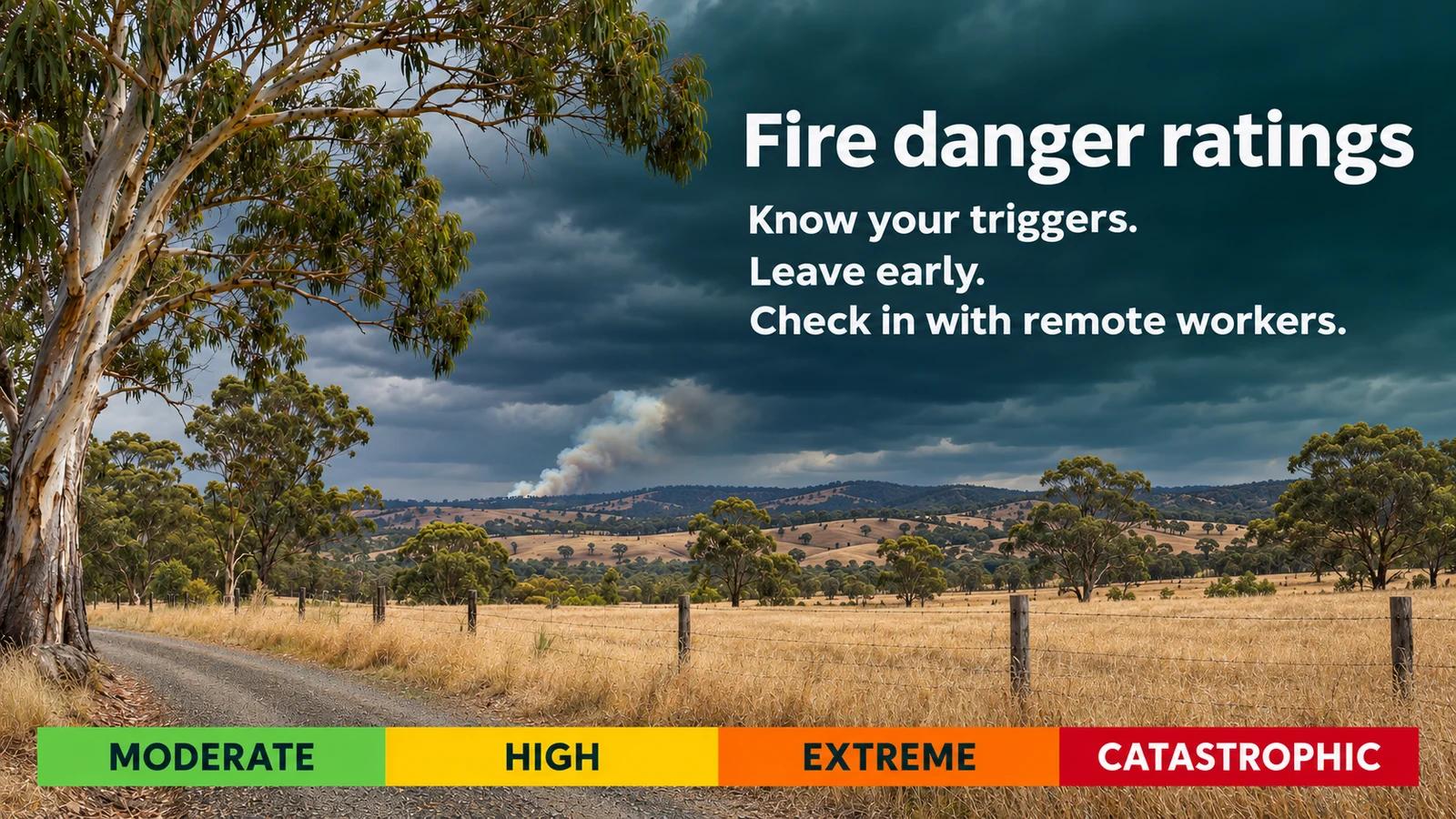
Australia uses four fire danger ratings: Moderate, High, Extreme and Catastrophic. Each one should mean something specific for your work. For example:
| Rating | What it could mean for your work |
|---|---|
| Moderate | Normal work. Check conditions and know the plan. |
| High | No hot work or slashing in dry grass without controls. Check remote workers in more often. |
| Extreme | No high-risk work in bush or grassland areas. Be ready to leave early. |
| Catastrophic | Do not travel to or work at high-risk sites. Leave early, or do not go. |
Write down who checks the rating each morning, who makes the call, and how it is passed on to people already in the field.
2. Where do our people go, and when?
For each site, decide in advance whether you evacuate or shelter in place, where the assembly point is, and what the trigger is to leave. Leaving early is always safer than leaving late. Roads close, smoke reduces visibility and storms bring down trees and powerlines.
3. How do we reach workers who are not in the building?
Travelling, remote and lone workers are the most exposed and the hardest to reach. Your plan should include:
- a check-in schedule that gets more frequent on high-risk days
- what happens when someone misses a check-in
- reliable communication where there is no mobile coverage, such as a satellite device or personal locator beacon
- a rule that nobody drives into an area under a current warning
4. What do we do on smoke days?
Bushfire smoke can affect workers hundreds of kilometres from the fire. The fine particles irritate the eyes and throat and can trigger asthma and heart problems.
- Check your state's official air quality readings, not just what you can see.
- Set trigger levels in advance: when outdoor work is reduced, rescheduled or moved indoors.
- P2 or N95 masks filter smoke particles when they fit well, but they do not filter gases, and they are not a reason to keep doing heavy work in thick smoke.
- Take extra care with workers who have asthma, heart or lung conditions, or who are pregnant.
- Indoors, close up and set air conditioning to recirculate.
5. How do we get back to work safely after a storm?
Many storm injuries happen in the clean-up, not the storm. Before work restarts, inspect the site for:
- Fallen or damaged powerlines. Treat them as live. Stay at least 8 metres away and call the network provider or 000.
- Damaged roofs, structures, scaffolds and fences.
- Fallen trees. Chainsaw work is for competent people only, and storm-damaged trees are unpredictable.
- Water in electrics and plant. Have a licensed electrician check before anything is switched back on.
- Mould, sewage and contamination after flooding.
- Asbestos in storm-damaged older buildings.
- Chemical spills from damaged containers or stores.
Make one person responsible for signing off that the site is safe before people go back to work.
Storm rules every worker should know
- When thunder roars, go indoors. Stay in until 30 minutes after the last thunder. Get off roofs, scaffolds, plant and open ground.
- If it's flooded, forget it. Never drive, walk or work in floodwater. It takes very little moving water to float a car.
- Pull over in heavy rain, hail or smoke if you cannot see. Park away from trees and powerlines, and put your hazard lights on.
- For flood and storm help, call the SES on 132 500. In a life-threatening emergency, call 000.
A pre-season checklist
- Review your emergency plan against bushfire, storm, flood and smoke.
- Agree on your fire danger and air quality triggers, and who decides.
- Check assembly points, evacuation routes and shelter areas for every site.
- Set up check-ins and emergency communication for remote and travelling workers.
- Clear gutters, dry vegetation and loose materials around buildings and yards.
- Check first aid kits, fire extinguishers, torches, radios and spare masks.
- Run a drill, including a "leave early" scenario.
- Brief every crew before the first hot, windy or stormy day.
Get the documents and training
We have put the plan, procedure and checklists above into a ready-to-use set:
- Severe Weather and Bushfire Pack: everything below plus our Emergency Plan Template, at a bundle price
- Bushfire and Severe Weather Emergency Plan: fire danger and warning triggers, shelter or evacuate, remote worker check-ins and a pre-season checklist
- Bushfire Smoke and Poor Air Quality Procedure: trigger levels, masks, workers at higher risk and a decision record
- Post-Storm Return to Work Inspection Checklist: what to check, and who signs off, before work restarts
To brief your crews, the Storm and Bushfire Season Awareness toolbox talk is a ready-to-run 20 to 30 minute session. For people working away from base, see the Lone and Remote Work Awareness talk and the Remote or Isolated Work Critical Control Verification Pack.
Summer brings the heat as well. Our Working in Heat post and Heat Stress Management Pack cover the hot days in between the storms.
If you would like help reviewing your emergency plan before the season, or fire warden training for your team, contact us.
This article is general information. It is not legal advice. Follow the warnings and directions of your state fire service, the SES and the Bureau of Meteorology.