
Worker Deaths Are at Their Highest Since 2012: The Controls That Matter Most
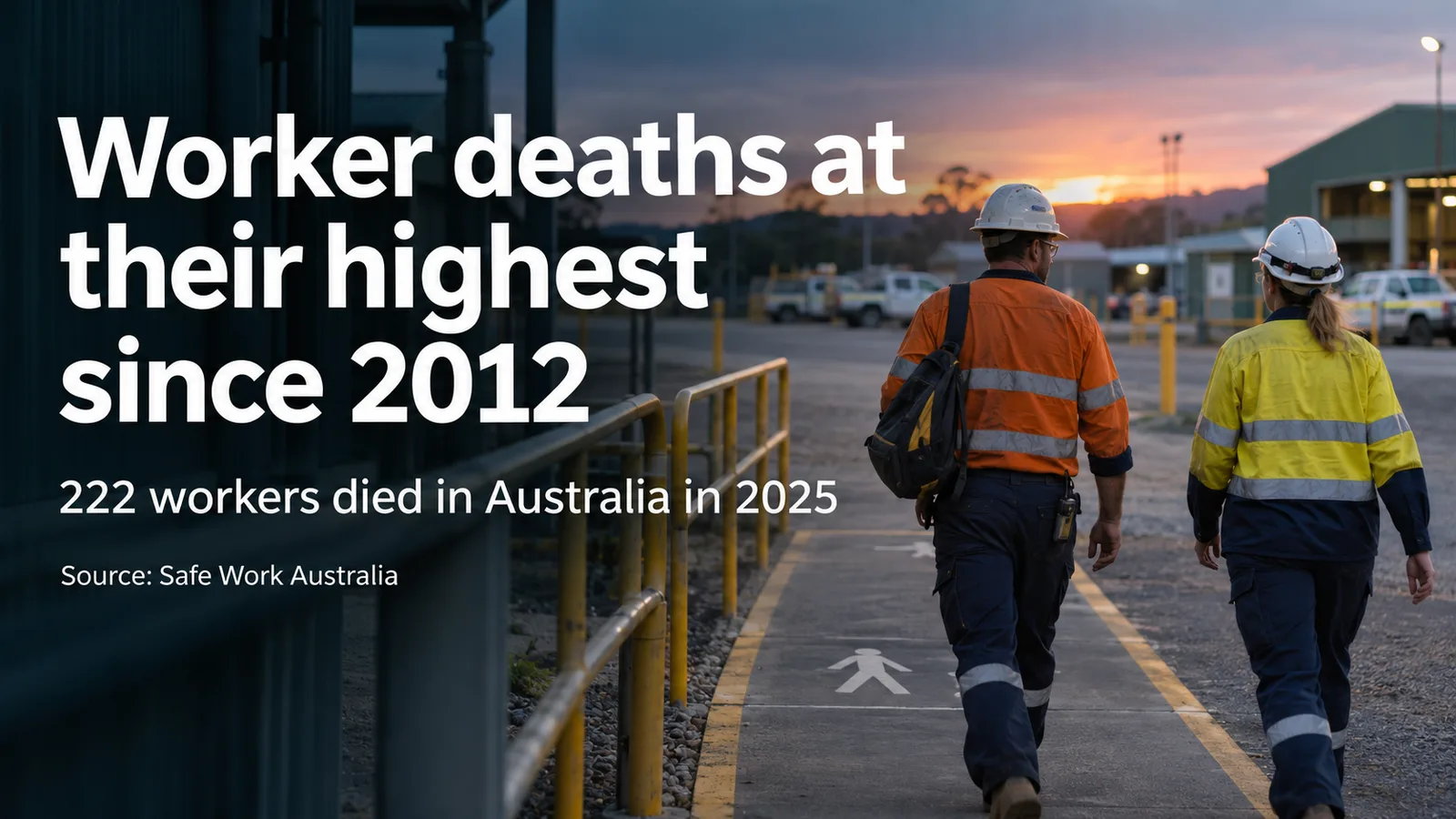
In 2025, 222 workers were killed at work in Australia. That is the highest number since 2012, and well above the five-year average of 197. The fatality rate rose to 1.5 deaths per 100,000 workers, up from an average of 1.4.
Those numbers come from Safe Work Australia's Key Work Health and Safety Statistics Australia 2026, released in October. Behind each one is a person who went to work and did not come home, and a family, a crew and a business that will carry it for years.
The hard part is not that these deaths are mysterious. It is that they are not.
Most deaths happen in a few familiar ways
The data points to the same small group of risks it has pointed to for years:
- Vehicle incidents caused 41% of worker deaths: road crashes, being hit by a moving vehicle or mobile plant, and rollovers.
- Falls from height caused 13%.
- Being hit by falling objects caused 9%.
Between them, those three account for nearly two in every three deaths.
The deaths are concentrated by industry too. Transport, postal and warehousing recorded the most, with 61, followed by construction with 41. Six industries together accounted for 74% of all worker deaths. And workers in very remote Australia were around eight times more likely to be killed at work than the national average.
None of these is a new or emerging hazard. The ways to control them are well known: separating people from moving plant, edge protection and fall arrest, exclusion zones under suspended loads, isolation before anyone reaches in. So why do people keep dying?
What recent prosecutions have in common
Look at a few recent cases in the NSW Industrial Court:
- A traffic controller fell about 10 metres into an excavation pit when a concrete pump malfunctioned during a pour. The company was fined a total of $170,000.
- A worker was seriously injured when the mobile elevated work platform they were working on tipped from the back of a truck trailer. The company was fined $140,000.
- A company was fined $238,000 after a 16-metre steel cage fell onto 11,000-volt overhead powerlines at North Wollongong.
In both of the first two releases, the Commission made the same point: the risk control measures for falls and for working around moving plant are well known. The controls existed on paper, in the industry and in the guidance. On the day, they were not in place, or not working, or not used.
That is the pattern behind most serious incidents. Not a lack of knowledge, but a gap between the control we think is there and the control that is actually there when it is needed.
Critical controls: the few that must work every time
A critical control is a control that must work, every time, to prevent a fatality, serious injury or catastrophic event, or to limit the harm if it happens. Its absence or failure would significantly increase the risk despite the other controls in place.
For the risks in the data above, critical controls look like this:
| Risk | Typical critical controls |
|---|---|
| Vehicle and mobile plant | Physical separation of people and plant, exclusion zones, traffic management plans that match the site on the day, seatbelts and rollover protection |
| Falls from height | Edge protection, scaffolds that are tagged and inspected, fall arrest that is anchored and used, controlled access to voids and roofs |
| Falling objects and suspended loads | Exclusion zones under lifts, rated and inspected lifting gear, secured loads |
| Powerlines and stored energy | Approach distances, spotters, isolation and testing for zero energy before work |
Most businesses can name these. The question that matters is the next one.
How do you know they are working?
Injury rates will not tell you. A site can go years without a serious injury while a critical control is quietly failing, because the events that kill are rare at any one workplace. By the time the injury data shows a problem, someone is already hurt.
What tells you is verification: going out to the work, as it is really done, and checking that each critical control is there, working, and would work if it were needed today. In practice that means:
- Pick the control and read its performance standard. What does "working" mean for this control, specifically?
- Watch the task as it is done, not as the procedure says it is done. Go at the times when shortcuts happen: night shift, end of the day, when the job is running late.
- Ask the crew. What gets in the way? When does this control get skipped, and why?
- Check the control itself, test it where it is safe to, and check the records.
- Record an honest result. Is the control effective? A Pass means it is in place and working. If it is not effective, the result depends on what fell short: if the control itself is missing, not working or bypassed, that is a Fail, and the work that relies on it stops. If the control works but a supporting item falls short, such as an overdue inspection record, that is a Non-conformance, fixed through an action with a date.
- Act on it. A Fail goes to the control owner straight away, and is treated as the high potential incident it is.
The temptation is to round up: to write "OK" when the barrier is mostly there, or the exclusion zone is mostly kept. Resist it. Honest verification will often find more problems at first. That is not things getting worse. It is seeing them for the first time.
Where to start this week
- List your critical risks. For most workplaces it is a short list: vehicles and mobile plant, work at height, suspended loads, energy, and whatever is specific to your work.
- Name the critical controls for each, and the person who owns each one.
- Go and verify one this week. Pick the control you would least like to be wrong about, and go and look at it, at the time of day the work actually happens.
Training and documents
Our online course Control Verifier teaches supervisors, leading hands and safety people to verify critical controls in the field: planning from the performance standard, observing, asking the crew, testing, rating results Pass, Non-conformance or Fail, and acting when a control fails. For the basics, start with the free Introduction to Critical Control Management, and for the people accountable for a control, see Critical Control Owner.
For the system around it, our instructor-led Critical Control Management course covers identifying critical risks, selecting critical controls, writing performance standards and building a verification program, and our Critical Risk Management services can help you set it up.
From our document store:
- Critical Control Verification Library: field verification checklists for your critical risks
- Verification packs for the risks in the data above, each with a bowtie, field verification forms and a schedule: Vehicle and Pedestrian Interaction, Light Vehicle Operation and Fall from Height
- Critical Risk Management Plan: name your critical risks, their controls and who owns them
Figures are from Safe Work Australia's Key Work Health and Safety Statistics Australia 2026 and SafeWork NSW prosecution releases. General information, not legal advice.
Want to keep up to date with WHS news? Subscribe to our mailing list
Critical Control ManagementWorkplace Health and SafetyRisk Management Articles