
Chronic Unease: The Useful Worry That Beats Christmas Complacency
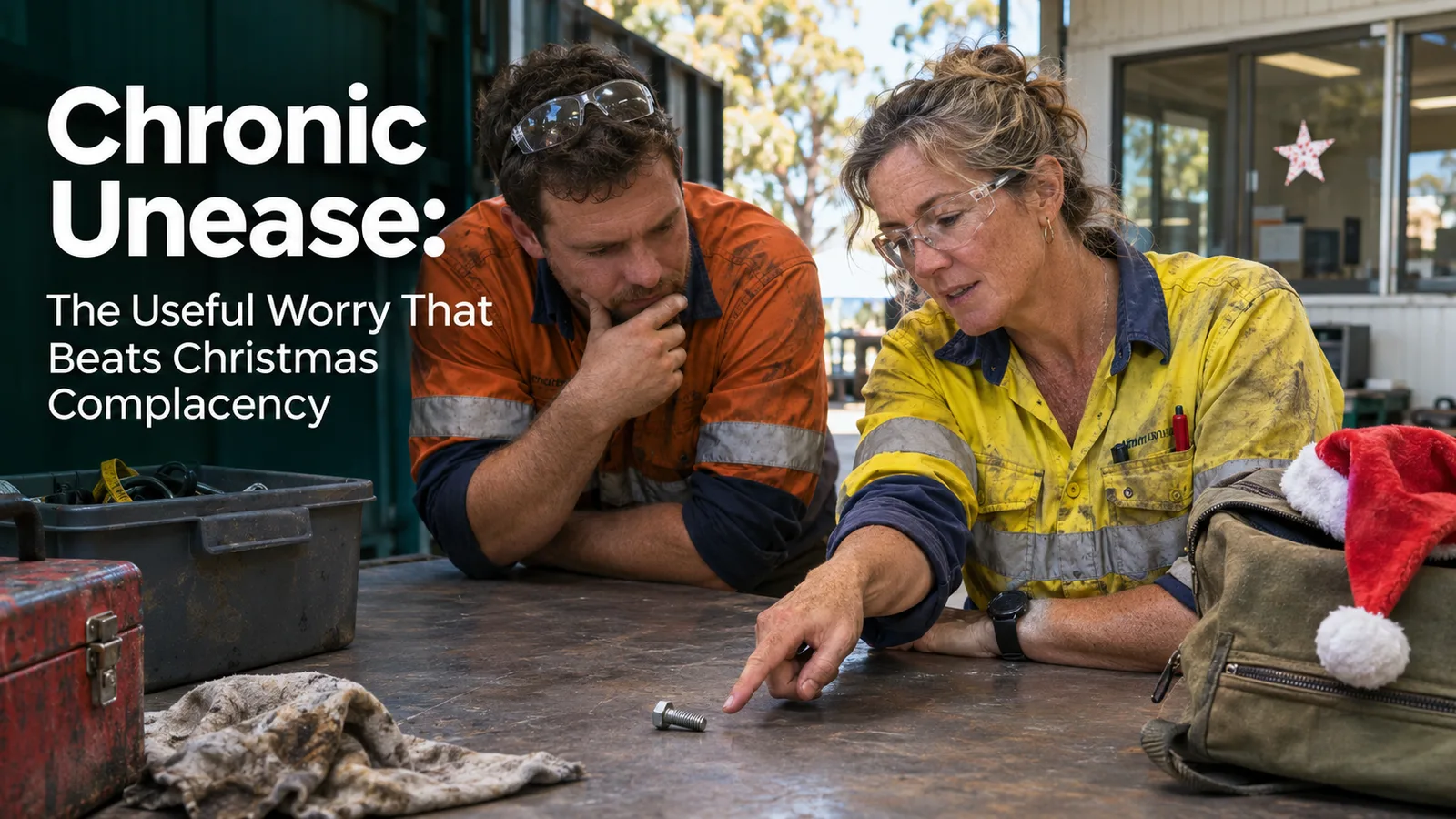
It is the last few weeks of the year. The site has gone months without a serious incident. Everyone is tired, the deadlines are stacking up before the shutdown, half the team is thinking about holidays, and the jobs that have been put off all year suddenly have to be finished.
This is exactly when a good safety record starts to work against you. A long run without an incident feels like proof that the controls are working. Often it only proves that nothing has gone wrong yet.
The antidote has a name: chronic unease.
What chronic unease is
Chronic unease is a constant, healthy wariness that things may not be as safe as they look. It is the habit of assuming there is something you have not seen yet, and going looking for it, rather than waiting for an incident to tell you.
It is not panic, and it is not pessimism about people. It is a steady, professional doubt about whether the controls on paper are the controls in the field today.
Where the idea came from
The idea is usually traced to the British psychologist James Reason, whose work on human error and organisational accidents shaped modern safety thinking. In Managing the Risks of Organizational Accidents (published in the late 1990s), Reason described the wariness that organisations need when the hazards are serious and the warning signs are rare. His point was simple: in the organisations that manage risk well, success does not breed comfort. It breeds questions.
The idea grew alongside research into high reliability organisations: aircraft carriers, air traffic control, nuclear power and others that operate with catastrophic hazards but very few accidents. Karl Weick and Kathleen Sutcliffe, who studied these organisations, described a preoccupation with failure as one of their defining habits. These organisations treat small errors and near misses as signs that something bigger could go wrong, rather than as proof that the system caught it.
Later, safety researchers Sabrina Fruhen, Rhona Flin and colleagues set out to define chronic unease more precisely, mainly by studying managers in high-hazard industries such as energy. They described five parts to it:
| Part | What it looks like |
|---|---|
| Pessimism | Assuming things can go wrong, even when they usually do not |
| Propensity to worry | A low-level concern about risks that does not switch off because the numbers look good |
| Vigilance | Actively watching for weak signals: the near miss, the workaround, the job that took longer than usual |
| Requisite imagination | Picturing how this job could go wrong today, with these people, in these conditions |
| Flexible thinking | Being willing to change your view, and the plan, when the situation changes |
The oil and gas industry in particular has taken up the term, and many large operators now talk about chronic unease as a quality they want in their leaders.
Why it matters most before Christmas
Complacency is not laziness. It is what happens to normal, capable people when things have gone well for a long time. The end of the year adds pressure from every side:
- The rush to finish. Jobs that must be done "before we close" create time pressure, and time pressure is where shortcuts come from.
- Fatigue. Long hours to clear the backlog, the end of a long year, Christmas functions and late nights all add up.
- Distraction. People are thinking about leave, family, travel and money.
- Different people doing different work. Casuals, labour hire and contractors fill gaps; shutdown maintenance brings tasks that are done once a year by people who have not done them for twelve months.
- Thin supervision. Supervisors take leave, and skeleton crews work with fewer people to check, help or raise the alarm.
- Heat. Summer is arriving, with all the extra strain that brings.
- The restart. In January, plant that has sat idle starts again, isolations may not have been fully cleared, and everyone is out of rhythm.
Each of these on its own is manageable. Together, they are the conditions in which the controls we rely on quietly stop working.
Using chronic unease well
Chronic unease is a mindset, but it shows up in specific behaviours. Here is what it can look like over the next six weeks.
Ask the uncomfortable question. Instead of "Is everything OK?", try "What is most likely to hurt someone on this job before Christmas?" and "What are we doing differently this week?"
Treat a good record as a reason to look harder. If you have had no incidents for a long time, go and check whether the controls are still there, rather than assuming they are. Pick the control you would least like to be wrong about, and go and look at it at the time the work is really done.
Listen for weak signals. A near miss, a "we always do it this way", a job that took twice as long as planned, a piece of equipment that "just needs a bump to start". These are the small warnings that come before big events.
Imagine the job going wrong. Before shutdown work and before the January restart, spend five minutes with the crew asking: what has changed since we last did this? Who has not done it before? What would we do if it went wrong?
Watch the people, not only the plant. Notice who is exhausted, who is distracted, who has had a hard year. A worker who is not coping is a safety issue as well as a wellbeing one.
Make it safe to raise concerns. Chronic unease only works if people will tell you what they see. Thank the person who stops a job or reports a near miss, even when it is inconvenient, and especially in the last week before the break.
A word of balance
Chronic unease is meant to be a healthy professional habit, not a source of constant stress. Fruhen and Flin's research with senior managers found it helped safety, but that it could also take a toll on the managers themselves. Worry that never switches off is not good for anyone, and it is not what good safety leadership needs.
The aim is a calm, curious doubt: "I don't know for sure this is safe, so let's find out", followed by a plan to check. Share that load across the team, so it does not all rest on one supervisor or safety advisor, and make sure the people carrying it get a proper break too.
This week
- Name the three jobs between now and the break that worry you most, and check their critical controls in person.
- Brief your crews on what is different about the end of the year: the rush, the fatigue, the contractors and the restart.
- Plan the January restart now, while the people who know the plant are still at work.
For shutdown work, see our Christmas shutdown contractor checklist, and for a deeper look at the gap between how work is planned and how it is really done, see Work as Planned, Work as Done. We have also written before about embracing chronic unease as a long-term habit.
Training and documents
For supervisors and leading hands, our online Frontline Supervisor course covers spotting risks, making good calls under pressure and leading a safe crew, and Control Verifier shows how to check in the field that critical controls are really working, and how to act when they are not. For managers, our instructor-led Critical Control Management course builds the system around it.
From our document store:
- Work As Done Review Kit and the Work as Planned, Work as Done Awareness Toolbox Talk, for finding the gap between the procedure and the job
- Fatigue Awareness Toolbox Talk and Fatigue Management Policy Template, for the end-of-year push
- JSA and Take 5 Form, for a short, real pause before the job starts
General information, not legal advice.
Want to keep up to date with WHS news? Subscribe to our mailing list